
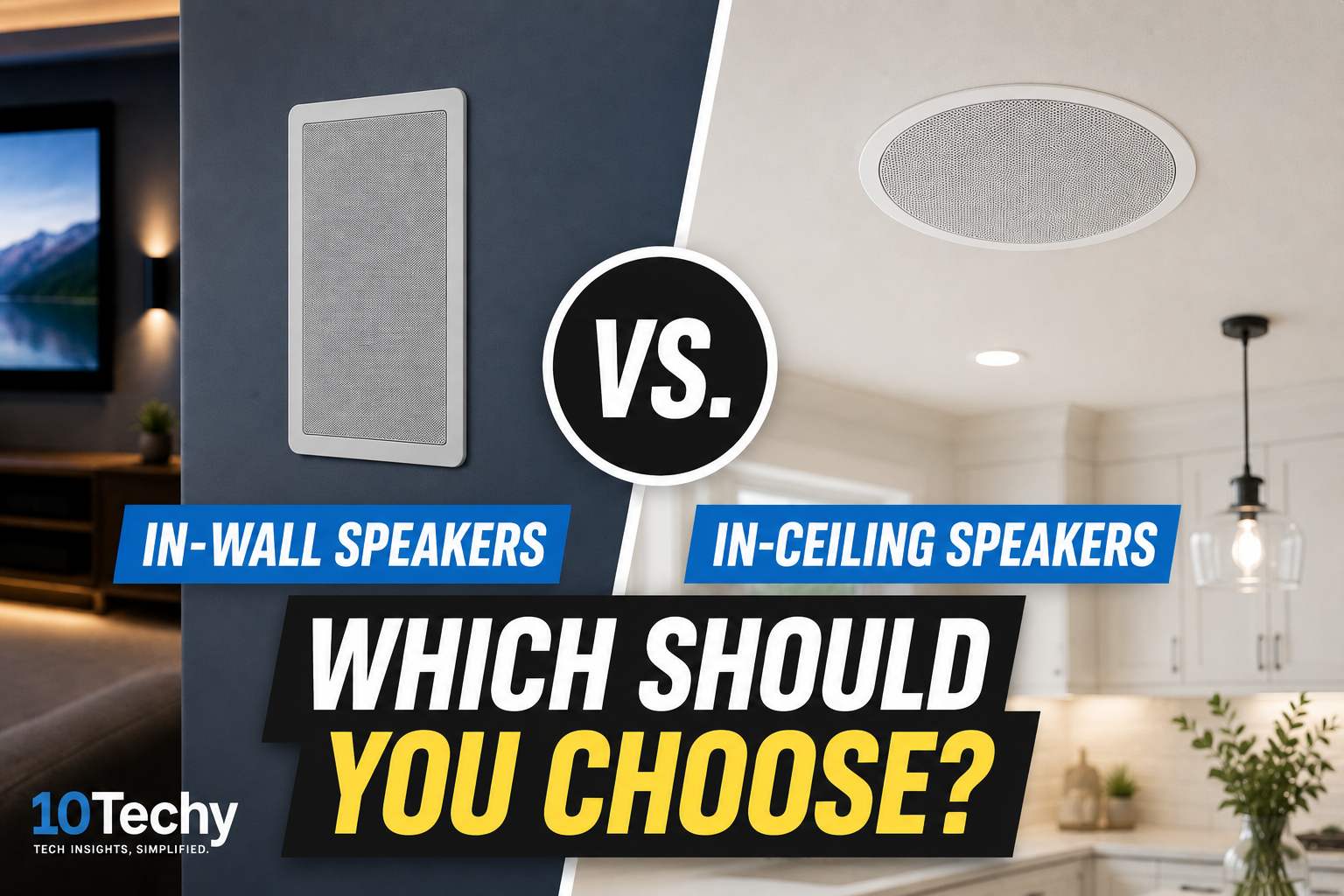
Most people get this wrong. They pick ceiling speakers for a home theater because they look cleaner, or they default to in-wall speakers for a kitchen because they sound more “serious.” Both decisions usually end in disappointment.
The choice between in-wall and in-ceiling speakers is not about brand, budget, or looks. It is entirely about how sound physically travels in a room and what your ears are supposed to hear. Get the placement wrong, and even a $1,000 speaker sounds worse than a $200 one installed correctly.
This guide is written for homeowners, DIYers, and home theater builders who are about to cut holes in walls or ceilings and need to know exactly which type to use and where.
Quick Answer
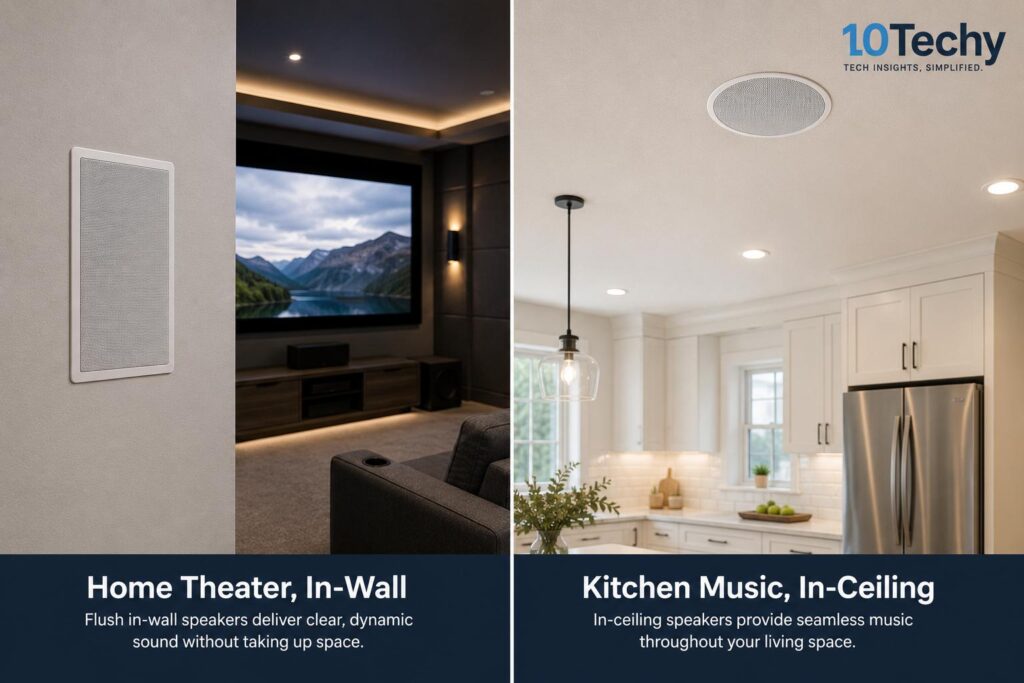
In-wall speakers fire sound horizontally at ear level. They are the right choice for home theater front channels (left, center, right), stereo music listening, and any room where sound needs to align with a screen.
In-ceiling speakers fire sound downward from above. They are the right choice for Dolby Atmos height effects, background music in kitchens and hallways, and whole-home distributed audio where no wall space is available.
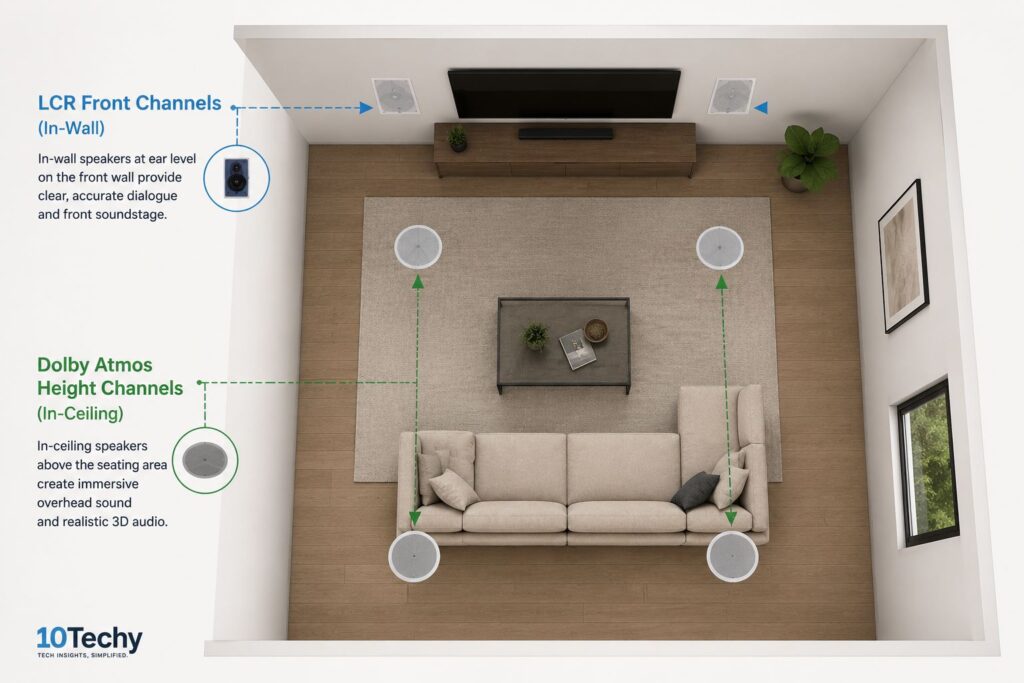
If you are building a home theater, use in-wall speakers for the front and surround channels, and in-ceiling only for Atmos overhead effects. If you are setting up background music for a kitchen or multi-room system, in-ceiling speakers win every time.
The Core Difference: It Is All About Direction
Before choosing, you need to understand one thing clearly. In-wall and in-ceiling speakers are not interchangeable versions of the same product. They serve different acoustic purposes because sound fires in completely different directions from each other.
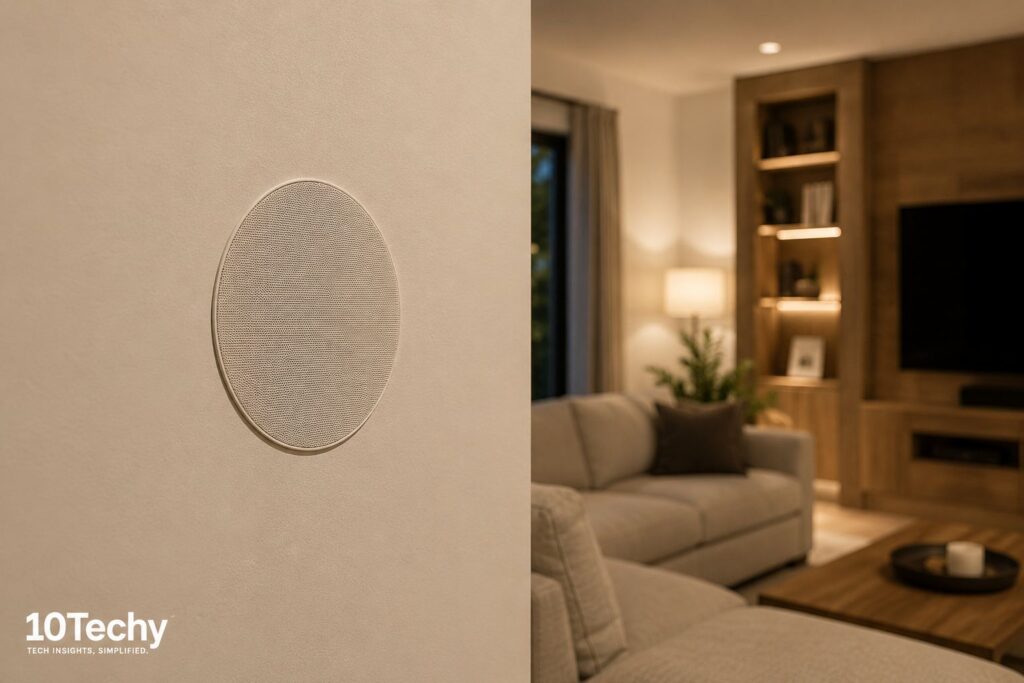
An in-wall speaker mounts vertically in a wall and fires horizontally across the room. That horizontal projection delivers sound directly to your ears when you are seated, exactly the way a traditional bookshelf or tower speaker does. This is why in-wall speakers are the right tool for anything that needs to feel like it is coming from in front of you, behind you, or to your side.
An in-ceiling speaker mounts horizontally in the ceiling and fires straight down. Some models feature pivoting tweeters you can aim toward the listening position, but the woofer, the part responsible for most of the sound, always fires downward.
This makes ceiling speakers naturally suited for overhead effects and wide ambient coverage, not focused stereo imaging.
This single distinction determines almost every placement decision you will need to make.
In-Wall Speakers: The Right Choice for These Situations
Home Theater Front Channels (LCR)
This is non-negotiable. Your left, center, and right speakers in a home theater must be in-wall, not in-ceiling. Full stop.
Here is why. When an actor speaks on your screen, your brain expects that voice to come from where the screen is, at eye level, in front of you. If the center channel is mounted in the ceiling instead of the wall, the dialogue physically separates from the image.
The voice sounds like it is coming from above the actor’s head. Audiophiles and home theater integrators call this the “Voice of God” effect, and it destroys cinematic immersion.
According to the Dolby Atmos Home Theater Installation Guidelines, the acoustic center of front soundstage speakers should sit approximately 3.9 feet (1.2 meters) from the floor, aligned with the ear height of a seated listener. That is an in-wall placement, not a ceiling placement.
The r/hometheater community on Reddit enforces this rule firmly. In threads comparing ceiling vs. wall placement for TV speakers, the consensus is absolute: all bed-layer speakers (front and surround) belong on walls or stands at ear level. The ceiling is reserved exclusively for Atmos height channels.
If you are planning a home theater and need product recommendations, our guide to the best in-wall speakers covers the top-performing options across every budget.
Dedicated Stereo Listening
If you want music to have a genuine left-right soundstage with proper imaging, where instruments feel like they occupy specific positions in space, in-wall speakers are your only architectural option.
Ceiling speakers collapse the stereo image because both drivers are firing downward from above. You hear music as a diffuse cloud of sound, not as a coherent stereo picture.
For a two-channel setup in a living room or dedicated listening room, in-wall speakers mounted at ear level, slightly toed in toward the primary listening position, will consistently outperform in-ceiling alternatives regardless of price.
Surround Channels in a Dedicated Theater Room
In a purpose-built home theater with four walls, your side surround and rear surround channels should also be in-wall speakers, mounted just above ear level on the side and rear walls. This placement matches how professional cinema engineers set up reference theaters. The surround sound wraps around you from the sides, not from the ceiling.
In-Ceiling Speakers: The Right Choice for These Situations
Dolby Atmos Height Channels
This is exactly what in-ceiling speakers were designed for in the modern era of immersive audio. In a Dolby Atmos setup, whether 5.1.2, 7.1.4, or larger, the overhead channels carry height effects: rain falling from above, a helicopter flying overhead, the cavernous reverb of a massive space.
To create this overhead illusion convincingly, the speakers must literally be above you. Dolby’s official guidelines specify that ceiling speakers for Atmos should be positioned at an elevation angle of 45 degrees relative to the primary listening position, with an acceptable tolerance of 30 to 55 degrees. Dedicated in-ceiling speakers achieve this naturally because they fire straight down from the ceiling.
Dolby also confirms that true in-ceiling speakers dramatically outperform the “Atmos-enabled” upward-firing modules that sit on top of bookshelf speakers and attempt to bounce sound off the ceiling.
The reflection-based approach works in acoustically ideal rooms but falls apart in real homes with irregular ceiling textures, beams, or furniture that disrupts the reflection path. For Dolby Atmos specifically, proper in-ceiling placement is the best solution available in a residential home.
Kitchen, Dining Room, and Open-Plan Living Spaces
For background music in living spaces, the goal is fundamentally different from home theater. You are not trying to create a focused soundstage with precise imaging. You want an even, ambient layer of sound that covers the entire room comfortably, whether you are at the kitchen island, the dining table, or the couch.
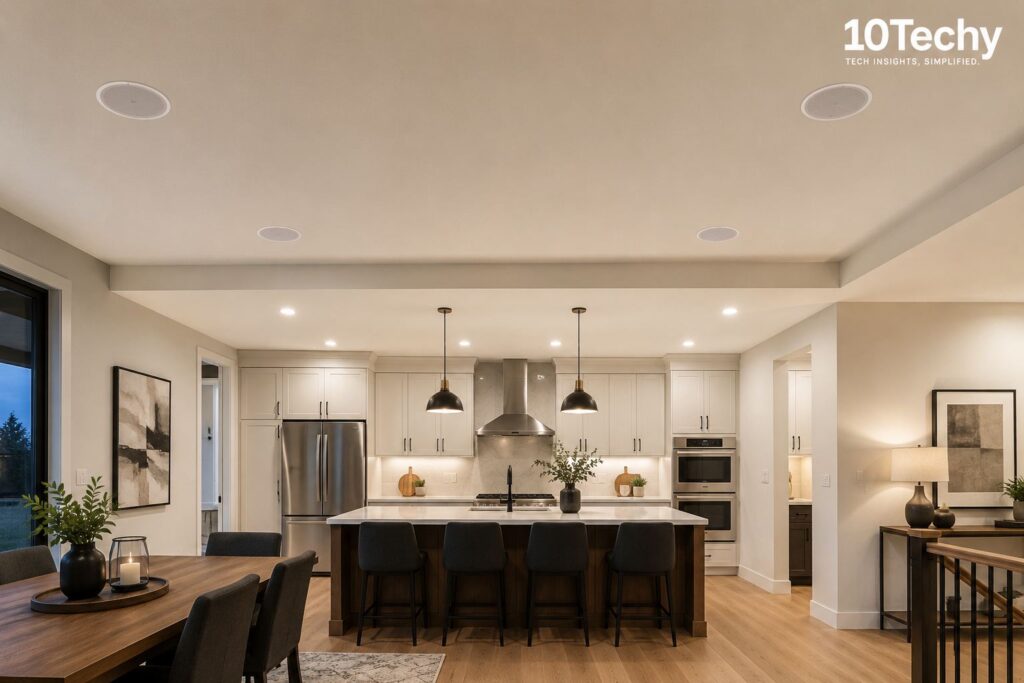
In-ceiling speakers are ideal for this because their downward-firing pattern naturally disperses sound across a wide area. They do not interfere with cabinetry, wall art, or furniture placement. They disappear into the ceiling alongside recessed lights and smoke detectors.
One important detail most guides skip: a single pair of ceiling speakers is rarely enough for a large open-plan space. Two speakers placed in the center of the room create “hot spots”, areas directly underneath where the volume is too loud, while the far corners of the room stay too quiet.
A proper installation for an open-plan kitchen-living area typically requires four to six evenly spaced ceiling speakers to maintain consistent volume across the whole space. If you are planning a multi-room music system, our whole-home audio setup guide walks through the full planning process, including how many speakers each room type typically needs.
Hallways, Bathrooms, and Confined Spaces
In narrow hallways, walk-in closets, and bathrooms, ceiling speakers are often the only practical architectural option. Walls in these spaces are too narrow, too close together, or too interrupted by doors and fixtures to mount in-wall speakers with proper spacing.
For bathrooms specifically, look for in-ceiling speakers rated for moisture resistance. Polypropylene cones, sealed motor structures, and rust-proof aluminum or plastic grilles are the details that separate speakers that last from speakers that corrode within two years of bathroom installation.
If a bathroom or closet only has space for one ceiling cutout, consider a dual-voice-coil stereo input speaker. These specialized units house both left and right channel inputs within a single chassis, so you get a proper stereo mix from a single speaker location.
Side-by-Side Comparison Table of In-Wall vs. In-Ceiling Speakers
| Factor | In-Wall Speakers | In-Ceiling Speakers |
|---|---|---|
| Sound Direction | Horizontal, fires at ear level | Downward, fires toward the floor |
| Best Application | Home theater LCR, stereo music, surround | Dolby Atmos height, background music, multi-room |
| Stereo Imaging | Excellent, focused left-right soundstage | Poor, diffuse overhead sound field |
| Atmos Performance | Not suitable for height channels | Ideal, correct overhead projection angle |
| Visual Footprint | Rectangular grille, visible on the wall. | Circular grille, blends with ceiling lights |
| Distributed Audio | Works but occupies wall real estate | Rectangular grille, visible on the wall |
| Bathroom/Hallway | Usually impractical (wall space too limited) | Natural fit, narrow spaces, moisture-rated options available |
| Open-Plan Coverage | Requires multiple placements | Better even-coverage distribution |
| Installation Complexity | Moderate, stud-finding, drywall cutting | Better, it does not interfere with furniture or decor |
| Back Box Requirement | Strongly recommended | Strongly recommended |
| Fire-Rated Wire Required | CL2 minimum (NEC code) | CL2 minimum (NEC code) |
Room-by-Room Decision Guide
Use this section as a direct lookup based on your space.
Dedicated Home Theater: In-wall for all LCR and surround channels. In-ceiling only for Dolby Atmos overhead effects. Never mix ceiling speakers into the front or surround bed layer.
Living Room with TV (Open Plan): In-wall for left and right front channels if you have a defined wall behind the TV. In-ceiling for surround in open-plan rooms where side walls are glass or nonexistent. In-ceiling for any Atmos overhead effects.
Kitchen: In-ceiling only. No exceptions. Walls are full of cabinetry. In-ceiling speakers provide the coverage pattern you need for ambient listening while cooking.
Dining Room: In-ceiling. Two speakers for rooms under 150 sq ft. Four speakers for larger dining areas.
Master Bedroom: Either works. An in-wall speaker for better stereo quality if you listen to music in bed. In-ceiling if you want background music and a clean, minimal ceiling.
Hallways and Bathrooms: In-ceiling. Always. Choose moisture-resistant models for bathrooms.
Home Office: In-wall delivers better stereo focus for music while working. In-ceiling works if wall placement is not practical.
The Technical Details That Actually Matter
Back Boxes: Not Optional
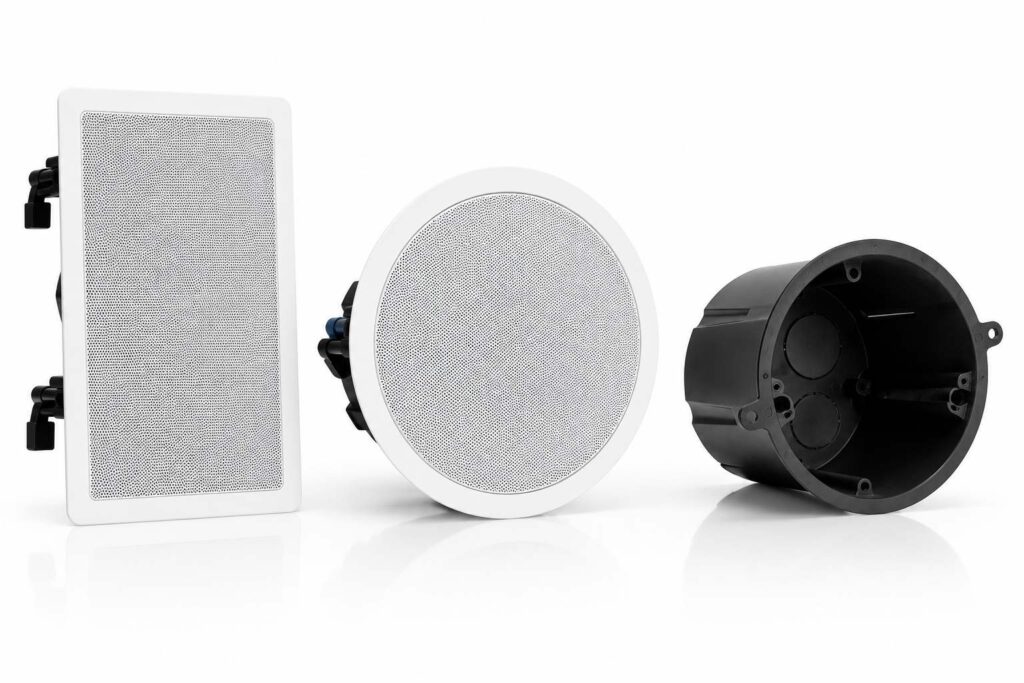
Most in-wall and in-ceiling speakers use an “open-back” design. The speaker mounts on the wall or ceiling with nothing behind it, just the open cavity of the wall or the attic above. This matters more than most buyers realize.
Without a sealed enclosure behind the driver, low-frequency sound bleeds freely through walls into adjacent rooms. A bedroom next to a home theater with open-back in-wall speakers will hear everything. A room below a ceiling speaker without a back box will hear a dull thump of bass through the floor.
A properly fitted back box, either factory-integrated or purchased separately for the speaker model you choose, traps the rear acoustic wave, tightens bass response, and prevents sound from escaping into the structure. This is not an upgrade for audiophiles. It is a baseline requirement for any serious installation.
For in-ceiling speakers located below an unconditioned attic, a back box also shields the speaker’s crossover and motor from insulation, moisture, and pests. Installing an open-back speaker into loose-fill blown insulation is a reliable way to destroy it within a few years.
CL2 vs. CL3 Wire: What the Building Code Actually Requires
Running standard lamp cord or generic speaker wire inside a wall is a building code violation in the United States. The National Electrical Code (NEC) under Articles 725 and 640 requires fire-rated low-voltage wiring for any cable run concealed behind drywall.
CL2 (Class 2) is the standard minimum for residential in-wall and in-ceiling audio. Its jacket is engineered to resist catching fire and, critically, to prevent the release of toxic gases if a fire starts elsewhere and reaches the cable run. For a typical home theater powered by an AV receiver or the best stereo receivers driving 8-ohm speakers, CL2 is all you need.
CL3 (Class 3) handles higher voltage and is required for commercial 70-volt distributed audio systems or extremely high-power residential setups. Most home installs do not need it.
Both CL2 and CL3 can be run through wall cavities without conduit in residential applications, which saves significant labor time compared to commercial installations.
For detailed guidance on cable ratings and fire safety, Blue Jeans Cable’s in-wall rating guide is one of the clearest technical references available.
Timbre Matching: The Detail Integrators Emphasize Most
When audio moves across multiple speakers in an immersive mix, say, an aircraft flying from a front left in-wall to an overhead in-ceiling, the transition needs to sound seamless. If the two speakers have different acoustic signatures (different tweeter materials, different crossover tuning), the sound changes character as it moves. You hear the transition rather than just the effect.
For this reason, professional integrators strongly recommend using the same brand and ideally the same product series for all speakers in a single room. Do not mix a soft silk dome tweeter from one brand with an aluminum dome tweeter from another and expect Atmos height panning to sound natural. It will not.
Common Mistakes to Avoid
Installing LCR speakers in the ceiling. This is the most damaging mistake in home theater setups. The audio disconnects from the visual, dialogue feels like it is coming from above the screen, and cinematic immersion collapses completely. If wall placement is not possible for your front channels, use an on-wall speaker before resorting to ceiling mounting.
Using one pair of ceiling speakers for a large open room. A single pair cannot cover a 400 sq ft kitchen-living space evenly. Hot spots form directly under the speakers while the edges of the room stay quiet. Plan for multiple speakers in a grid layout for any space above 200 sq ft.
Skipping the back box. This is not optional. Sound bleed into adjacent rooms, muddy bass, and speaker hardware damage from attic exposure are all direct consequences of open-back installations.
Mixing brands across the room. Even at similar price points, mixing speaker brands causes audible inconsistency in immersive audio panning. Stick to one series for the entire room.
Using non-rated speaker wire inside walls. This is a building code violation. Use CL2 minimum. It is the same price as generic wire and available at any hardware store.
Top Architectural Speaker Brands Worth Knowing (2026)
You do not need to spend a fortune on architectural speakers to get excellent results. But the brand you choose matters because it affects timbre matching across channels.
Polk Audio RC80i / MC80, The benchmark for distributed background audio. These best ceiling speakers offer 8-inch woofers, aimable silk dome tweeters, and moisture resistance at under $250 a pair. The right choice for outfitting multiple rooms on a realistic budget.
Klipsch CDT / R Series: Higher sensitivity ratings mean these speakers play louder at lower amplifier power. A good match for larger rooms or installations where the amplifier has limited headroom.
KEF Ci Series uses KEF’s Uni-Q concentric driver, which places the tweeter at the acoustic center of the woofer. This delivers exceptionally wide, even dispersion, particularly useful for ceiling speakers covering large seating areas.
Focal 300 Series, Premium option for home theaters. The 300 IW6 (in-wall) and 300 ICW8 (in-ceiling) are designed as a matched pair with identical acoustic signatures, solving the timbre-matching issue by design.
Bowers & Wilkins CWM Series is frequently recommended in audiophile and home theater communities for in-wall LCR applications. Known for clear midrange and natural dialogue reproduction.
For wireless-enabled distributed audio that works seamlessly with Apple devices, our roundup of the best AirPlay speakers includes several architecturally compatible options that integrate into multi-room setups without complex wiring.
Final Recommendation
Choose in-wall speakers if: You are building a home theater with a defined front wall, setting up a stereo music system in a dedicated room, or placing surround channels in a room with accessible side walls.
Choose in-ceiling speakers if: You are installing Dolby Atmos height channels in any configuration, setting up background music in a kitchen, dining room, bathroom, or hallway, or building a whole-home distributed audio system.
Use both if: You are building a complete home theater with immersive audio. In-wall handles the bed layer (LCR and surrounds), in-ceiling handles the Atmos overhead channels. This is the correct configuration and what Dolby’s installation guidelines specify.
The speakers themselves are only half the decision. Match them to the right amplifier, use CL2-rated wire throughout, fit a back box behind every driver, and stick to a single brand or series across all channels in a room. Do all of that, and the installation will perform far above what the component price suggests.
FAQs
Can you use in-ceiling speakers as front speakers for a home theater?
No, not if you want proper cinematic audio. In-ceiling speakers fire downward, which separates dialogue from the screen position and creates the “Voice of God” effect where speech seems to come from above the action on screen. Dolby Atmos guidelines require front LCR speakers to be at ear level, approximately 3.9 feet from the floor. That requires in-wall speakers, not ceiling-mounted ones.
Is in-wall or in-ceiling better for whole-home background music?
In-ceiling speakers are better for distributed whole-home audio. They fire downward across a wide area, cover more of the room evenly, and do not consume wall space that could conflict with furniture or decor. For multi-room systems, plan four to six ceiling speakers for large open-plan spaces rather than relying on a single pair per room.
Do in-wall and in-ceiling speakers need a separate amplifier or receiver?
Yes. Both types are passive speakers; they require an external amplifier or AV receiver to drive them. For multi-room distributed audio, a dedicated amplifier with multiple zone outputs or a whole-home audio controller is the right approach. For a home theater, a standard AV receiver handles all channels. Our guide to the best stereo receivers covers two-channel options if you are driving in-wall speakers for a music listening setup.
What is the correct Dolby Atmos ceiling speaker placement angle?
Dolby’s official guidelines specify that overhead in-ceiling speakers should be positioned at a 45-degree elevation angle relative to the primary listening position, with a tolerance range of 30 to 55 degrees. The horizontal width between front and rear overhead pairs should be 50 to 70 percent of the total width of the overall speaker layout at the listening level. Placing speakers outside this geometry reduces the effectiveness of height-based audio effects.
Do in-ceiling speakers work for Dolby Atmos in a room with a low ceiling?
Yes, but with caveats. Dolby’s reflective Atmos module guidelines (for upward-firing speakers on top of bookshelf speakers) require a flat ceiling between 7.5 and 12 feet high with a highly reflective surface like drywall or plaster. Vaulted or angled ceilings make reflective Atmos modules unreliable. True in-ceiling speakers perform significantly better across a wider range of ceiling heights because they fire directly at the listener rather than relying on a ceiling reflection.
What speaker wire rating do I need for in-wall and in-ceiling speakers?
CL2-rated speaker wire is the legal minimum for any cable run concealed inside residential walls or ceilings under the National Electrical Code (NEC). CL2 wire has a fire-resistant jacket that slows flame propagation and prevents toxic gas release if a fire reaches the cable. Standard zip cord or generic clear speaker cable is not code-compliant for in-wall use. CL3 wire (rated for higher voltages) is required only for commercial 70-volt systems.


