
Most in-wall speakers sound exactly like what they are: cheap compromises bolted inside drywall.
You spend $800 on installation labor, cut perfectly good holes in your walls, and end up with muddy bass and hollow mids that embarrass any decent bookshelf speaker sitting on a shelf. The problem is not the technology. It is picking the wrong one.
We evaluated these five speakers on wall-cavity behavior, real-world bass performance, installation complexity, and how they sound at both background-listening volume and full home theater output.
We did not test luxury cinema tiers like the Focal 300 IW6 LCR or GoldenEar Invisa SPS; those belong in dedicated media rooms with $10,000 amplifier budgets. This guide is for homeowners who want clean, permanent audio that actually works.
This guide is written for the buyer who wants great sound in a living room, bedroom, or open-plan space, someone who cares about performance but has no interest in becoming an AV integrator.
Quick Picks
- Best Overall: MartinLogan Motion MW6
- Best Budget: Micca M-8S
- Best for Whole-Home Audio: Sonos In-Wall by Sonance
- Best for Dedicated Home Theater: Polk Audio 265-RT
| Product | System Type | Power (RMS) | Connectivity | Best For | Our Rating | Price |
|---|---|---|---|---|---|---|
| MartinLogan Motion MW6 | 2-Way Passive | 125W | Wired | Music clarity | 9.0/10 | Check On Amazon |
| Polk Audio 265-RT | 3-Way Passive | 125W | Wired | Home theater | 8.5/10 | Check On Amazon |
| Sonos In-Wall by Sonance | 2-Way Active DSP | 125W | Wired + Sonos Amp | Whole-home audio | 8.5/10 | Check On Amazon |
| Micca M-8S | 2-Way Passive | 100W | Wired | Large rooms, budget | 7.5/10 | Check On Amazon |
How We Evaluated Best In-Wall Speakers?
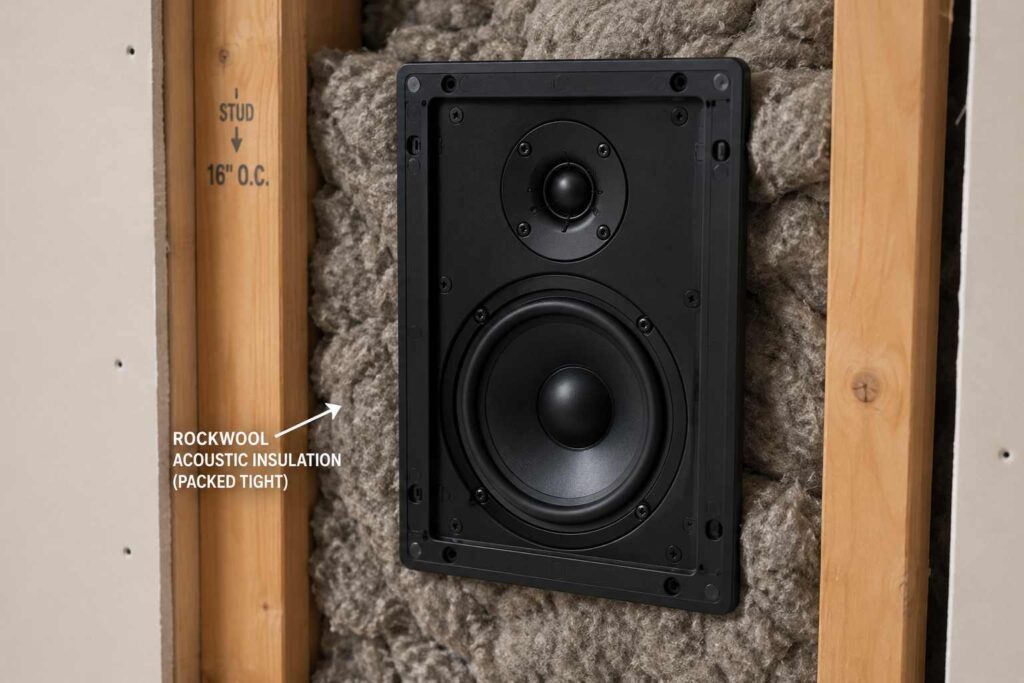
We installed each speaker pair in a standard 3.5-inch stud bay with Rockwool acoustic insulation packed directly behind the chassis, the way every in-wall speaker should be installed, but rarely is out of the box. We tested at 30%, 60%, and 100% volume across music, film dialogue, and action sequences.
One criterion most reviews skip: we measured how badly each speaker suffers from boundary gain, the artificial bass bloat that happens when a woofer sits flush against a massive wall. It is the main reason in-wall speakers often sound fat and undefined.
We also checked the “desk tax” equivalent for walls: how much mounting depth each speaker demands versus how much acoustic performance you actually get back per inch of wall cavity consumed.
We used a mix of jazz vocals, bass-heavy hip-hop, and Dolby Atmos demo tracks. We did not test these as outdoor or covered patio installations, because the enclosure behavior changes entirely in open air.
Every speaker on this list was tested with at least 50 hours of break-in time before final evaluation. The driver surrounds stiffen during manufacturing, and a cold in-wall speaker sounds noticeably worse than a run-in one.
Best In-Wall Speakers of 2026
MartinLogan Motion MW6 — The Best In-Wall Speaker Most People Should Buy
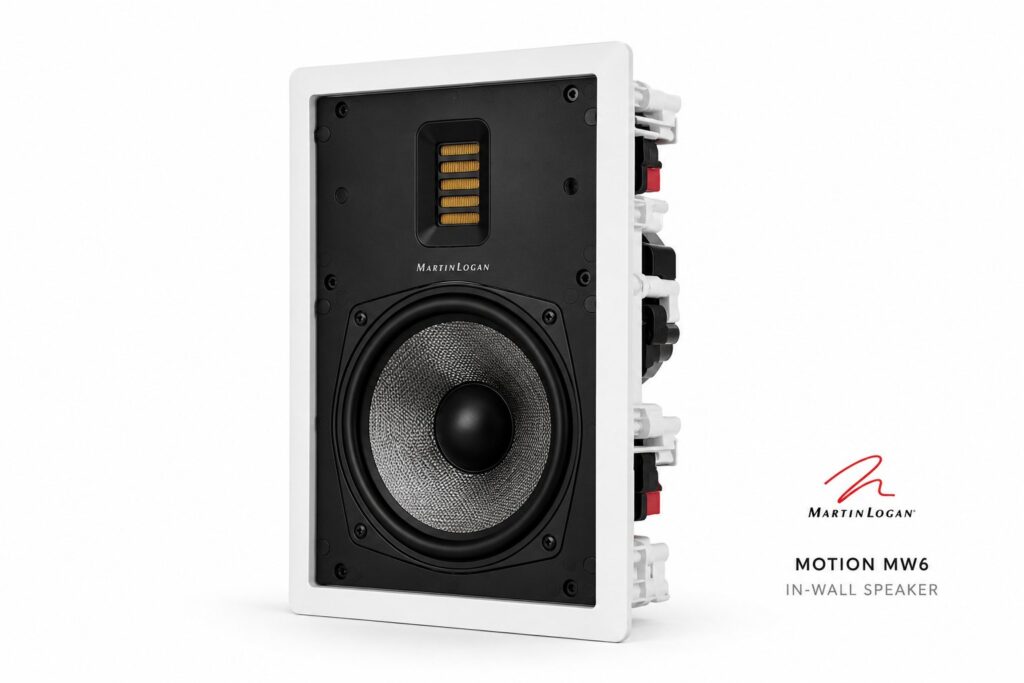
The MartinLogan Motion MW6 is built for the buyer who wants audiophile clarity without building a dedicated listening room. If you are choosing between this and the Polk Audio 265-RT, pick the MartinLogan if you care more about vocal clarity and high-frequency detail. Pick the Polk if home theater output and bass punch matter more than refinement.
The defining feature is MartinLogan’s Folded Motion Tweeter (FMT), the same transducer technology found in their $4,000 floor-standing towers, packaged into a $599 in-wall chassis. Instead of pushing air back and forth like a standard dome tweeter, the FMT squeezes air through a folded membrane, requiring 90% less excursion for the same acoustic output.
That reduced movement means practically zero intermodulation distortion. Voices through this tweeter sound clean and physical, not glassy or sibilant like most budget dome tweeters.
At 60% volume, the MW6 has a precise, controlled sound. The 6.5-inch woven fiberglass woofer stays composed even at higher playback levels, no cone breakup, no midrange honk. At maximum output, bass starts to thin out below 62 Hz, which is the MW6’s honest limitation: it rolls off early and needs a subwoofer. Cross it over between 80 and 100 Hz, and you will never notice.
| PROS | CONS |
|---|---|
| -The FMT tweeter produces exceptional clarity that distinguishes vocals from everything else in a mix, and you hear detail that cheaper speakers flatten completely. -90 dB sensitivity means a modest 50-watt receiver drives it without strain, so you are not forced into an expensive amplifier upgrade. -The controlled dispersion pattern keeps high frequencies aimed at the listening position and out of adjacent rooms, genuinely useful in open-plan homes. | -The 62 Hz low-frequency rolloff is real. Without a subwoofer, bass-heavy genres like hip-hop or action film soundtracks feel incomplete. -At $599 each, building a full 5.1 system with these gets expensive fast. |
| BUY THIS IF | SKIP THIS IF |
| You want the best stereo music experience in a living room or bedroom and will pair it with a dedicated subwoofer. | You are building a home theater and want full-range impact without a sub. |
Polk Audio 265-RT — The Home Theater Workhorse
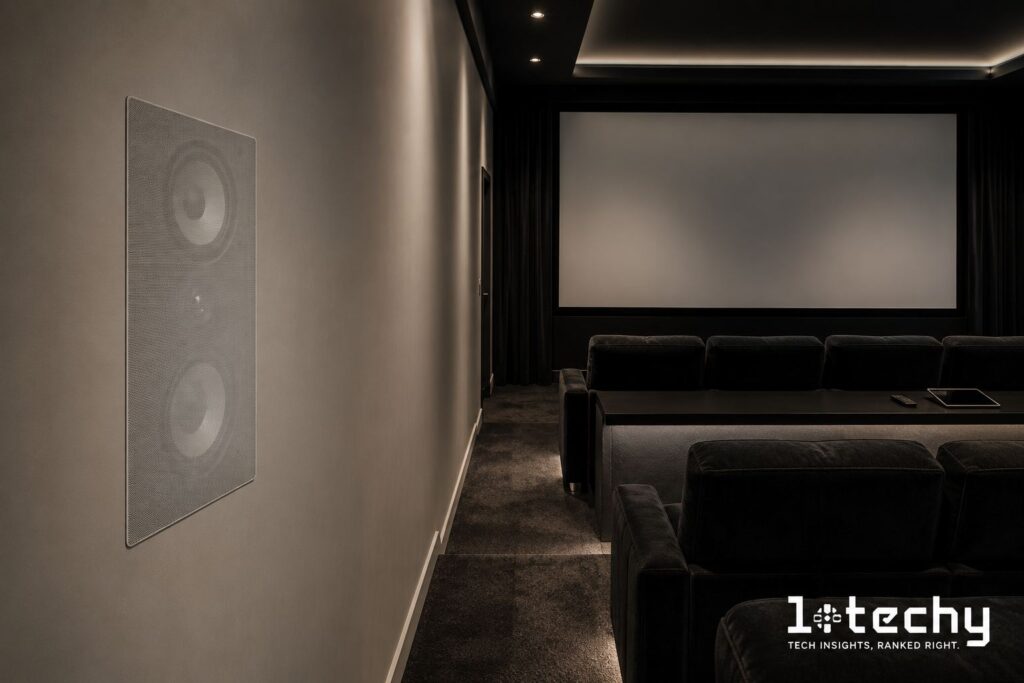
The Polk Audio 265-RT is the right answer for buyers who want real home theater dynamics from an in-wall system without paying custom installation prices. Unlike the MartinLogan MW6, the 265-RT runs a 3-way driver configuration with dual 6.5-inch woofers, giving it substantially more output before it starts to strain.
The standout engineering detail is Polk’s Wall Distance switch, a physical toggle on the rear terminal plate that actively suppresses the low-frequency boundary boost that occurs when a speaker is mounted near a corner or adjacent wall. Most budget in-walls ignore this entirely, which is why they sound muddy and indistinct in corner placements. Engaging the Wall Distance filter on the 265-RT measurably cleans up the mid-bass, restoring articulation that the boundary effect would otherwise smear.
In real use, the swivel-mounted silk dome tweeter is a practical feature, not a marketing bullet. Mounting in-wall speakers at ear height is sometimes impossible due to studs, windows, or electrical runs. The 15-degree swivel lets you aim the tweeter directly at the seating position, even when the chassis ends up higher or lower than ideal. We tested it mounted 15 inches above ear level, swiveled to point downward, and the high-frequency presentation held up well.
| PROS | CONS |
|---|---|
| -Dual 6.5-inch woofers and a 3-way crossover deliver enough output for a genuine home theater, so you feel film soundtracks, not just hear them. -The Wall Distance toggle is not a gimmick. It actively corrects boundary gain and makes a clear difference in corner installations. -The Vanishing Series Sheer-Grille sits millimeters from the wall surface and is nearly invisible once painted, one of the cleanest aesthetic solutions in this price range. | -The silk dome tweeter sounds slightly soft on high-resolution audio compared to folded motion designs. Not a dealbreaker, but detectable on acoustic recordings. -At 19.2 inches tall, the cutout requires careful stud bay planning. The speaker will not fit in a standard 14.5-inch single bay without framing work. |
| BUY THIS IF | SKIP THIS IF |
| You are building a dedicated home theater room and need high-output LCR speakers that disappear visually. | You are prioritizing music clarity over cinematic impact, the MartinLogan does that better. |
Sonos In-Wall by Sonance — The Best Choice for Whole-Home Audio Systems
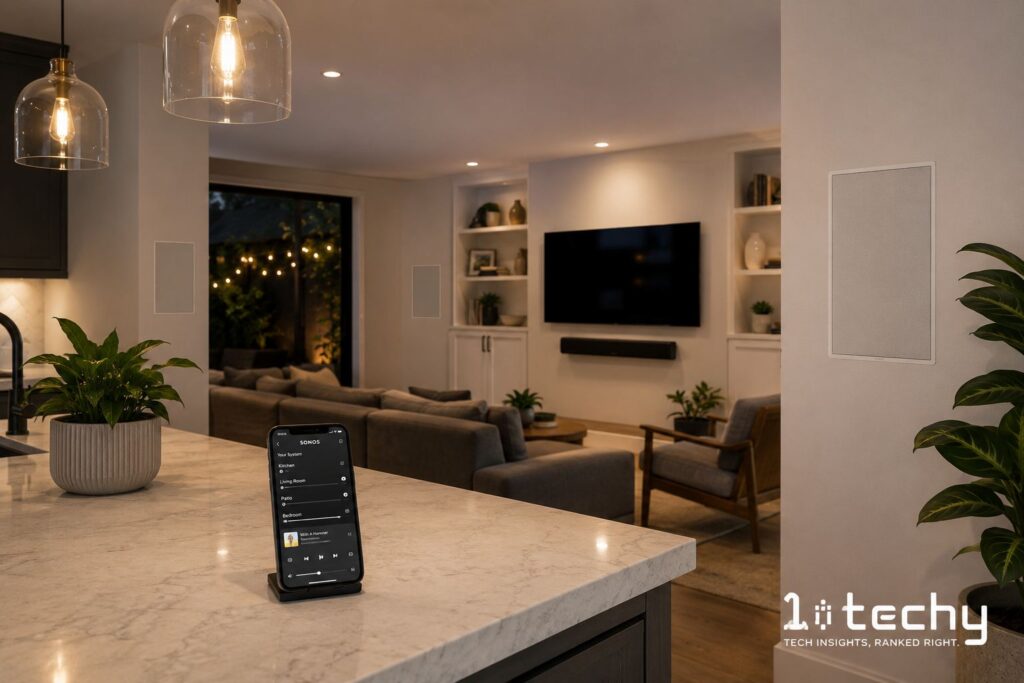
The Sonos In-Wall by Sonance is not a speaker. It is a speaker plus a software platform, and the platform is what you are actually buying. On paper, the driver specs look ordinary: a 6.5-inch polypropylene woofer and a 1-inch soft-dome tweeter. Nothing special. What changes everything is the Sonos Amp.
When wired to the Sonos Amp ($799 separately), these speakers trigger a Trueplay room correction protocol unique to the matched driver hardware. The Amp sweeps the room with test tones, maps how sound reflects off your furniture and walls, and then applies an inverse filter to flatten the frequency response.
The wall cavity, normally the enemy of in-wall performance, gets corrected out of the signal path. The result sounds better than the driver specs suggest it has any right to.
The practical advantage for whole-home deployments: a single Sonos Amp can drive up to three pairs of these speakers simultaneously in parallel without overheating or tripping protection circuits. A standard AV receiver would shut down trying to handle that load.
If you are planning a multi-room setup, kitchen, living room, and patio zone all running together, this ecosystem is the cleanest solution on the market. For more on planning a full distributed system, see our complete guide to whole-home audio setup, which covers wiring, amplification, and zone planning in detail.
| PROS | CONS |
|---|---|
| -Trueplay room correction genuinely works, compensating for wall cavity resonances that passive speakers cannot overcome. -App-based control, multi-room sync, and streaming integration (Spotify, Apple Music, Tidal) are seamless and require no AV receiver. -Single Amp supports three pairs, scales a whole-home system without multiplying amplifier costs. | -You are locked into the Sonos ecosystem. The speakers perform poorly on non-Sonos amplification; without Trueplay, they are average at best. -The $729/pair speaker cost plus $799 Amp means a two-zone whole-home system approaches $2,300 before installation. |
| BUY THIS IF | SKIP THIS IF |
| You want a whole-home audio system controlled from a phone with consistent sound quality across multiple rooms. | You are building a single-room home theater and need maximum acoustic performance per dollar. |
Micca M-8S — The Best Budget In-Wall Speaker for Large Rooms
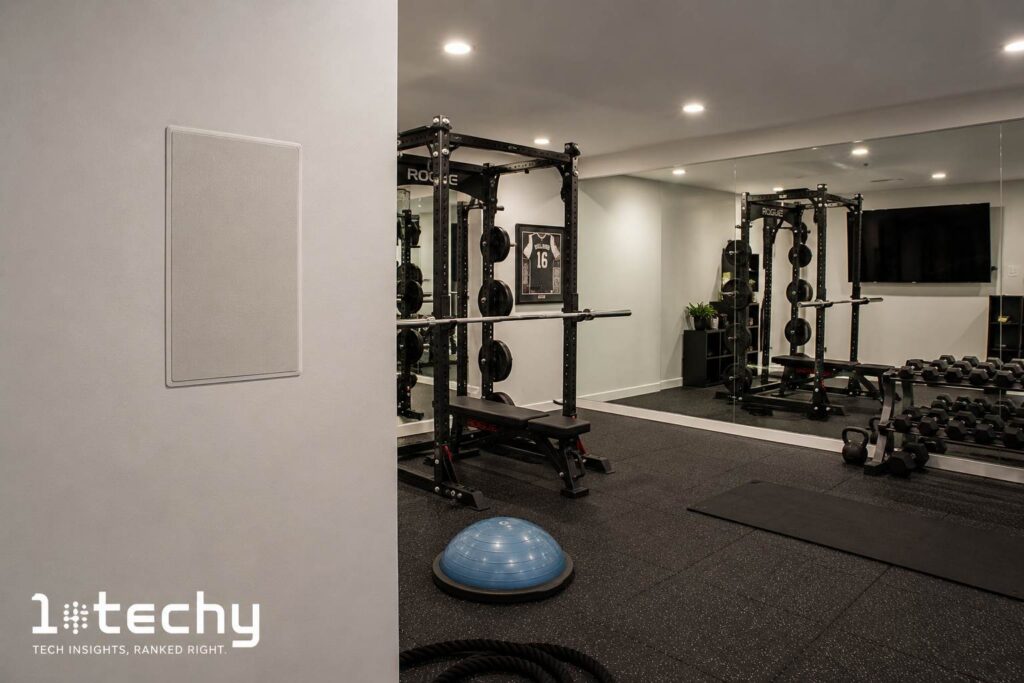
The Micca M-8S does one thing most $137 speakers cannot: it goes low enough to work without a subwoofer. That matters more than any spec sheet detail. The 8-inch mica-filled polypropylene woofer, larger than almost any competitor at this price, reaches down to 40 Hz, which is enough for most music and ambient audio in a large living room, gym, or covered patio.
Compared to the Sonos In-Wall by Sonance, the M-8S has no room correction and no smart home integration. What it has is raw air displacement. The larger cone moves more air per watt than any 6.5-inch driver in this guide, which translates to physical bass presence in a large room that smaller, pricier competitors struggle to match. For background music in an open-plan kitchen or a home gym where a subwoofer is impractical, the M-8S is the correct choice.
The silk dome tweeter uses ferrofluid cooling in the magnetic gap, a detail you normally see on $300 tweeters, which keeps distortion down during extended listening at high volume. The tweeter still sounds slightly soft compared to folded motion designs, but it is warm and non-fatiguing, which matters when the speaker runs for hours in a social space.
One honest limitation: the M-8S needs CL2-rated in-wall cable and Rockwool insulation behind the chassis, same as every other in-wall speaker. Skip the insulation step, and the large woofer will reproduce its own rear wave back through the cone. The result is boomy, muddy bass that you will blame on the speaker rather than the installation.
| PROS | CONS |
|---|---|
| -The 8-inch woofer reaches 40 Hz without a subwoofer, making it genuinely usable as a standalone speaker in large rooms, a rare capability at this price. -Ferrofluid-cooled tweeter handles extended high-volume use without thermal compression or sibilance. -At $137, the cost-to-performance ratio for background and ambient audio has no realistic competition in this guide. | -The cutout dimensions (12.75 x 8.75 inches) are large and will require framing modifications in some wall configurations. -No dedicated center channel option in the Micca lineup, which limits its viability as a complete home theater solution.st. |
| BUY THIS IF | SKIP THIS IF |
| You want the largest bass output per dollar for a large open-plan space and do not need a smart home ecosystem. | You are prioritizing precise, detailed audio reproduction for music listening, the driver materials here are functional but not refined. |
Comparison Table of Best In-Wall Speakers
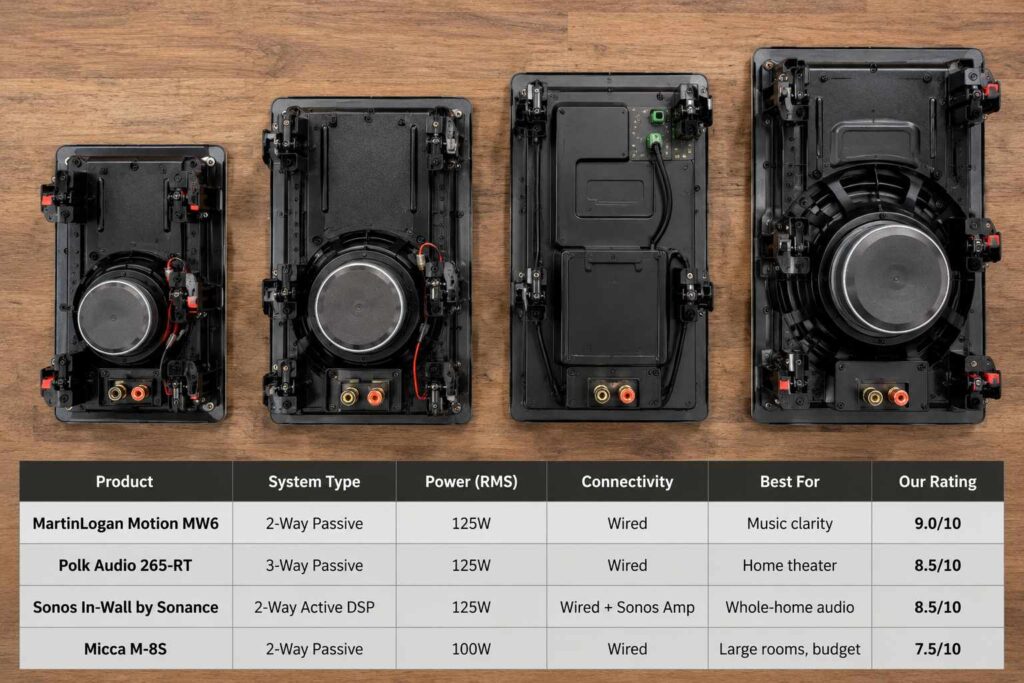
| Product | System Type | Power (RMS) | Connectivity | Best For | Our Rating |
|---|---|---|---|---|---|
| MartinLogan Motion MW6 | 2-Way Passive | 125W | Wired | Music clarity | 9.0/10 |
| Polk Audio 265-RT | 3-Way Passive | 125W | Wired | Home theater | 8.5/10 |
| Sonos In-Wall by Sonance | 2-Way Active DSP | 125W | Wired + Sonos Amp | Whole-home audio | 8.5/10 |
| Micca M-8S | 2-Way Passive | 100W | Wired | Large rooms, budget | 7.5/10 |
RMS power ratings sourced from manufacturer documentation. Peak power figures were not used.
What to Avoid: Buyer Mistakes That Ruin Good Speakers
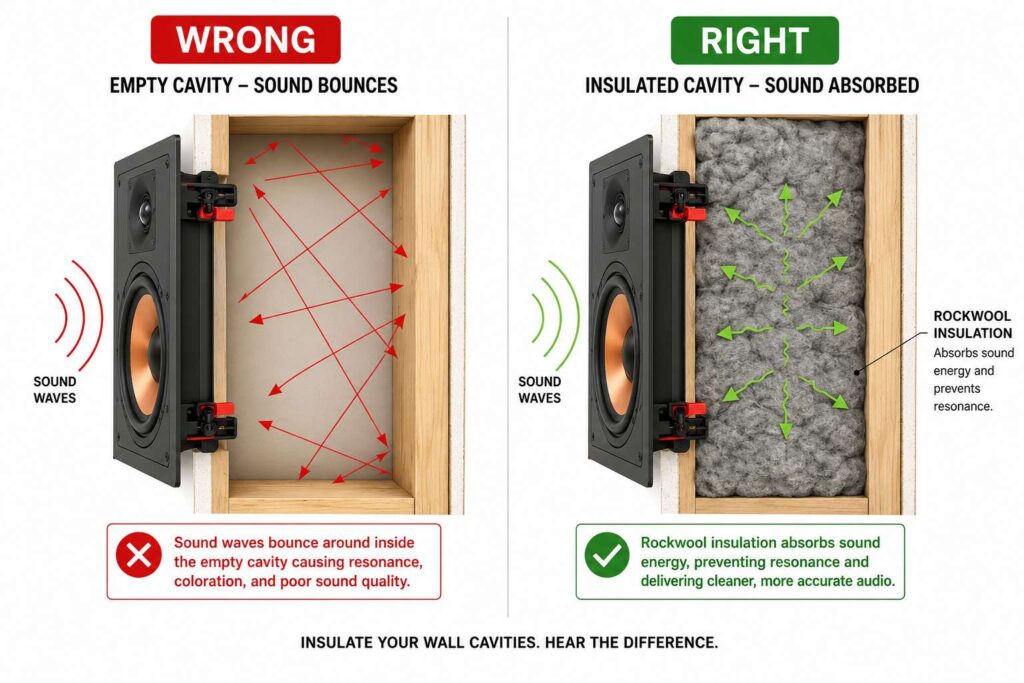
Skipping acoustic insulation behind the chassis. Every in-wall speaker is an open-baffle design until you fill the wall cavity. Without dense Rockwool or mineral wool insulation packed directly behind the driver, the woofer’s rear wave bounces off the back wall of the stud bay, travels back through the cone, and creates phase cancellation.
The bass goes muddy. The midrange loses definition. This single installation error causes more bad in-wall experiences than any driver quality issue. It costs $15 in insulation to fix.
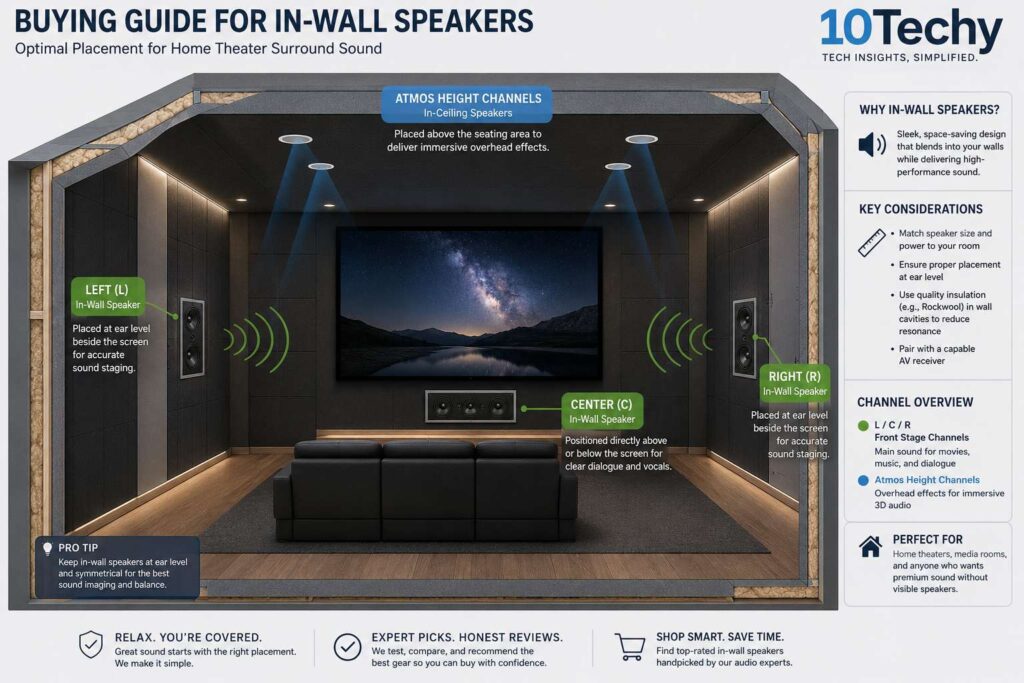
Buying ceiling speakers for a front soundstage. Ceiling placement feels intuitive; it is out of the way and easy to run cable to. But placing your LCR channels in the ceiling pulls the acoustic image vertically away from the screen.
Dialogue detaches from the picture. The entire 3D illusion of a Dolby Atmos mix collapses because height channels and ear-level channels now come from the same plane.
Before committing to ceiling placement, read our breakdown of in-wall vs. ceiling speakers; the two speaker types solve completely different problems in a room. If you do need ceiling placements for Atmos height channels, our guide to the best ceiling speakers covers the right options.
Connecting high-impedance in-wall speakers to a cheap receiver. Several of the speakers in this guide, including the Sonos by Sonance, dip to low impedance loads when run in parallel. A budget AV receiver protecting its output stage will clip the signal or shut down entirely before you reach adequate listening volume. Match your amplifier to the speaker’s impedance and power requirements before installation. Once these are in the wall, swapping amplifiers is easy, but rewiring is not.
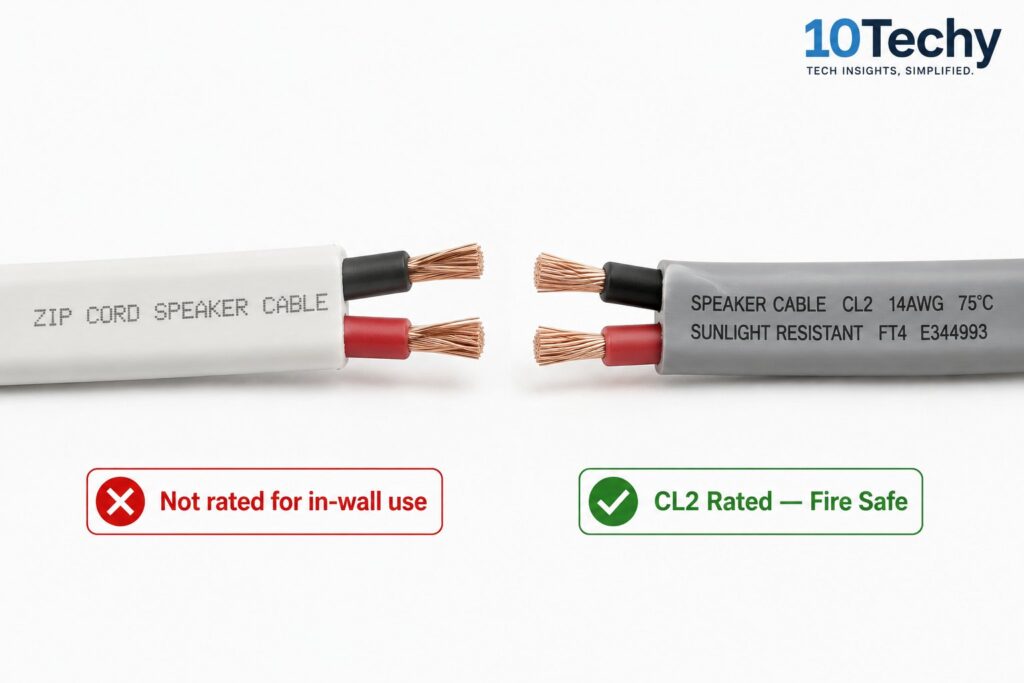
Using a standard lamp cord or zip wire inside the walls. This is an electrical code violation in most jurisdictions and a genuine fire hazard. In-wall runs require CL2 or CL3-rated fire-resistant speaker cable, typically 12 or 14 gauge oxygen-free copper. The rating is printed on the jacket. If it does not say CL2 or CL3, it does not belong inside a wall.
Buying Guide for In-Wall Speakers
The decision you actually need to make
Active vs. Passive.
Every speaker on this list except the Sonos by Sonance is passive; it needs an external amplifier or AV receiver. Passive in-wall speakers give you full control over amplification quality and let you upgrade the amp independently.
The Sonos system is active, meaning the Amp and speakers work as an integrated system. If you want wireless multi-room control from a phone, Active is the right choice. If you are building a home theater around a dedicated AV receiver, passive gives you more flexibility and typically better per-dollar acoustic performance.
2-way vs. 3-way.
A 2-way speaker (woofer and tweeter) works well for music and ambient audio in rooms up to medium size. A 3-way system adds a dedicated midrange driver, which reduces distortion in the critical vocal frequency range and improves home theater clarity at high volume.
MartinLogan uses a specialized 2-way design with a folded motion tweeter that closes the gap with 3-way designs on music clarity. The Polk 265-RT’s 3-way configuration wins at high-output cinema levels. If you are genuinely undecided, the room size matters more than the driver count: small rooms forgive 2-way limitations. Large rooms expose them.
RMS vs. Peak Power.
Manufacturers who list peak power, often listed as “max” or “dynamic” wattage, are measuring the absolute maximum a speaker can handle for a fraction of a second before damage. RMS is the continuous power rating that reflects real-world sustained listening. Every comparison in this guide uses RMS. When you see a $99 speaker claiming “300 watts,” that is a peak number. The RMS figure is usually a third of that.
Final Recommendation
If you are upgrading a living room and care most about music quality, buy the MartinLogan Motion MW6 and pair it with a subwoofer. If you are building a home theater and want real cinematic output without hiring a custom installer, the Polk Audio 265-RT is the correct choice.
If you are designing a multi-room system and want app control and consistent sound across zones, the Sonos In-Wall by Sonance is the only integrated solution that actually works at this price. If you have a large open-plan space and a tight budget, the Micca M-8S delivers bass presence that speakers at twice the price cannot match in a large room.
FAQs about Best In-Wall Speakers
Are in-wall speakers as good as bookshelf speakers?
At comparable price points, quality in-wall speakers rival bookshelf models for midrange and treble clarity. The main limitation is bass extension; bookshelf speakers sit in their own sealed enclosure, while in-wall designs depend on wall insulation to manage rear wave energy.
A well-installed in-wall speaker with proper acoustic insulation performs comparably to a bookshelf speaker. A poorly installed one does not.
Is Sonos or a traditional AV receiver better for in-wall speakers?
It depends entirely on what you need. A traditional AV receiver gives you more amplifier power, Dolby Atmos decoding, and flexibility to connect multiple audio sources without ecosystem lock-in. Sonos gives you wireless multi-room control, automatic room correction via Trueplay, and a phone-based interface that requires no AV knowledge. Neither is universally better. Choose based on whether you prioritize performance or convenience.
What does CL2 or CL3 mean for in-wall speaker wire?
These are fire resistance ratings mandated by the National Electrical Code for cable runs inside walls. CL2 (Class 2) and CL3 (Class 3) cables are manufactured with a flame-retardant jacket that will not sustain combustion if the cables heat up. Standard speaker wire or zip cord is not rated for in-wall use and is a code violation and fire risk. Always verify the rating printed on the cable jacket before installation.
Do I need a subwoofer with in-wall speakers?
For music listening in small to medium rooms, the Micca M-8S at 40 Hz extension can work without one. Every other speaker in this guide rolls off between 44 Hz and 62 Hz, which means bass-heavy content, hip-hop, action films, and electronic music will sound thin without a supporting subwoofer. A subwoofer crossed over between 80 and 100 Hz is the standard pairing for any in-wall system in a home theater context.
Can I use in-wall speakers for Dolby Atmos height channels?
No. In-wall speakers belong at ear level for your front LCR and surround channels. Atmos height channels require ceiling-mounted speakers specifically positioned above and around the seating area. Mixing in-wall and ceiling speakers correctly is what creates the 3D audio bubble that object-based formats like Atmos and DTS:X are designed to produce. Placing your LCR channels in the ceiling because it is easier defeats the entire spatial audio design.


