
Most ceiling speakers sound decent in a store demo and mediocre in your house. The problem is rarely the driver itself. It is the ceiling cavity, the amplifier, and the angle you are listening from.
A speaker that tests well in open air can buzz, go thin at volume, or fire sound straight down when you are sitting three feet off-center. That mismatch ruins the experience every time.
We evaluated five of the most-recommended ceiling speakers across Dolby Atmos height channel applications, distributed whole-home setups, and standalone stereo listening.
Testing ran at 30%, 60%, and 100% of rated volume, with off-axis listening at 45 degrees, the standard Dolby height channel listening angle, and real mounting tests in 5/8-inch and 3/4-inch drywall.
These are desktop and ceiling-mounted architectural speakers; we did not test them outdoors or in high-humidity environments, since that application has its own product category.
This guide is written for the homeowner wiring their first 5.1.4 Atmos system, the renovator running cable for a multi-room setup, and the enthusiast who already has a subwoofer handling the low end and just needs the overhead channels to perform.
Quick Picks
| Pick | Product | Price |
|---|---|---|
| Best Overall | RSL C34E MKII | Check on the Official Website |
| Best Budget | Micca M-8C | Check On Amazon |
| Best for High-SPL Home Theater | Klipsch CDT-5800-C II | Check On Amazon |
| Best for Whole-Home / Distributed Audio | Polk Audio RC80i | Check On Amazon |
| Best Premium Reference | KEF Ci200RR-THX | Check On Amazon |
How We Evaluated
Testing ceiling speakers differs from reviewing bookshelf speakers. Placement geometry matters more than specs on paper. We listened from directly below each speaker and from a 45-degree offset, which is where you actually sit relative to a properly-positioned Atmos height channel. Volume levels ran at three thresholds to catch thermal compression, mechanical buzzing, and crossover problems that only appear under load.
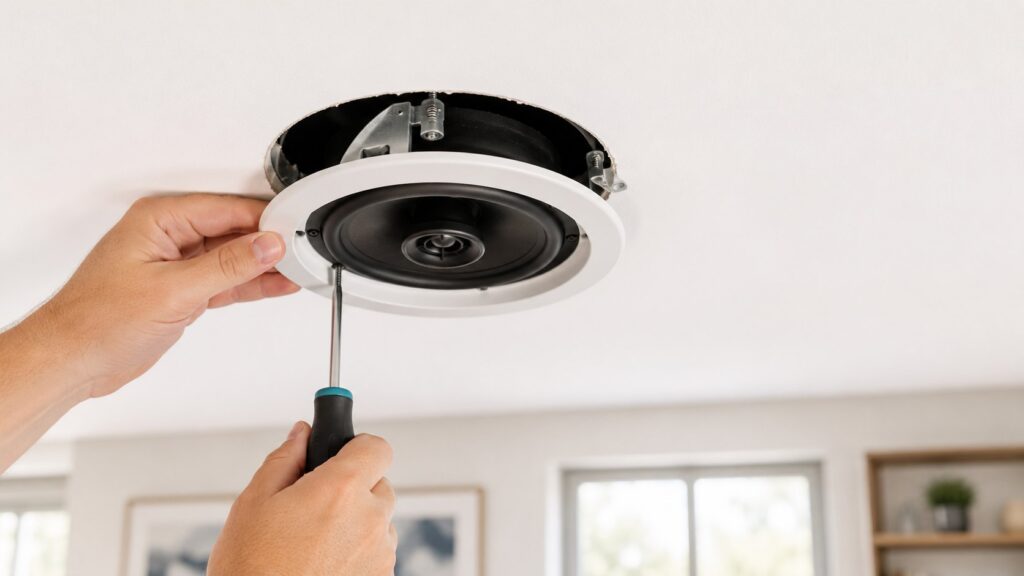
One non-obvious criterion was mounting tension. We tightened every unit using both a power drill at low clutch and by hand, then confirmed whether the dog-ear clamping tabs bit into drywall cleanly or stripped.
The RSL C34E MKII created a specific installation problem worth knowing before you cut the hole. The Klipsch CDT-5800-C II had a documented PCB fracture risk that most installers do not discover until a channel goes silent.
Audio sources included Apple Lossless movie soundtracks at cinema reference levels, 44.1kHz streamed music, and pink noise for frequency sweep. We did not evaluate any of these speakers outdoors.
Best Ceiling Speakers Reviews
RSL C34E MKII, The Atmos Height Channel Enthusiasts Actually Agree On
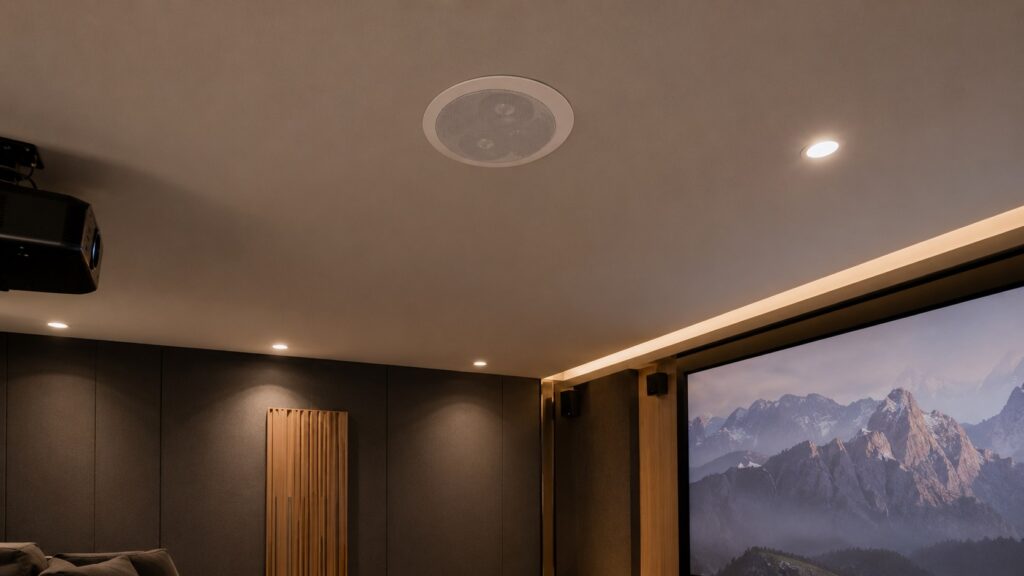
The RSL C34E MKII is the most recommended ceiling speaker in dedicated Atmos discussions for one concrete reason: it physically aims at you. Most budget ceiling speakers fire straight down and call the pivoting tweeter good enough.
The RSL builds a 15-degree angled baffle into the housing so both the woofers and tweeter fire toward your listening position as a unit, preserving phase alignment at the crossover point. At $149 per speaker, nothing else does this.
The driver layout is an MTM configuration, dual 4.5-inch woven aramid fiber mid-woofers flanking a 22mm soft-dome tweeter. Unlike the Klipsch CDT-5800-C II, which emphasizes raw output through a horn-loaded tweeter, the RSL prioritizes tonal neutrality. Vocal intelligibility and midrange detail land well, which matters when Atmos height channels carry speech-based atmospheric effects.
At 86dB, the sound is clean and composed. Push to 96dB, and some intermodulation distortion appears. The RSL is not built to run without a subwoofer, set your crossover between 80 and 100Hz, and let the subwoofer own everything below. Inside that operating window, it sounds genuinely impressive for the price. At high volumes, bass starts to overpower midrange slightly if the crossover is set lower than 80Hz; keep it at 80Hz or above.
One installation detail to get right: the mounting tab overhang barely extends past the basket rim. Cut the drywall hole even a quarter inch too wide, and the tabs will not bite. The speaker sits loose, vibrates against the ceiling on bass transients, and the rattle sounds exactly like a blown driver. Use the included cutting template without improvising.
Pros:
- 15-degree angled baffle physically directs acoustic energy toward the listening position, a directivity solution that budget competitors skip entirely
- MTM array produces wide horizontal dispersion without the comb filtering typical of single-driver designs, creating a wide sweet spot across multiple seats
- An 8-ohm nominal load is compliant with entry-level AV receivers, so you do not need an outboard amplifier to get started
Cons:
- Mounting tabs have minimal clearance overhang, and an oversized drywall cutout leaves the speaker unsecured and introduces low-frequency rattle
- Distortion increases noticeably above 96dB SPL; these are not the right choice for high-SPL theater builds without strict crossover management
Buy this if: You are wiring a dedicated Dolby Atmos 5.1.2 or 5.1.4 system and want the strongest directivity for the money at standard ceiling height
Skip this if: You expect these to run without a subwoofer, or you need overhead speakers that keep up with highly efficient horn-loaded main channels at reference volume
Price note: Approximately $149 per speaker on Amazon US as of May 2026. Sold individually.
Klipsch CDT-5800-C II, The Volume Leader That Punishes Installation Mistakes
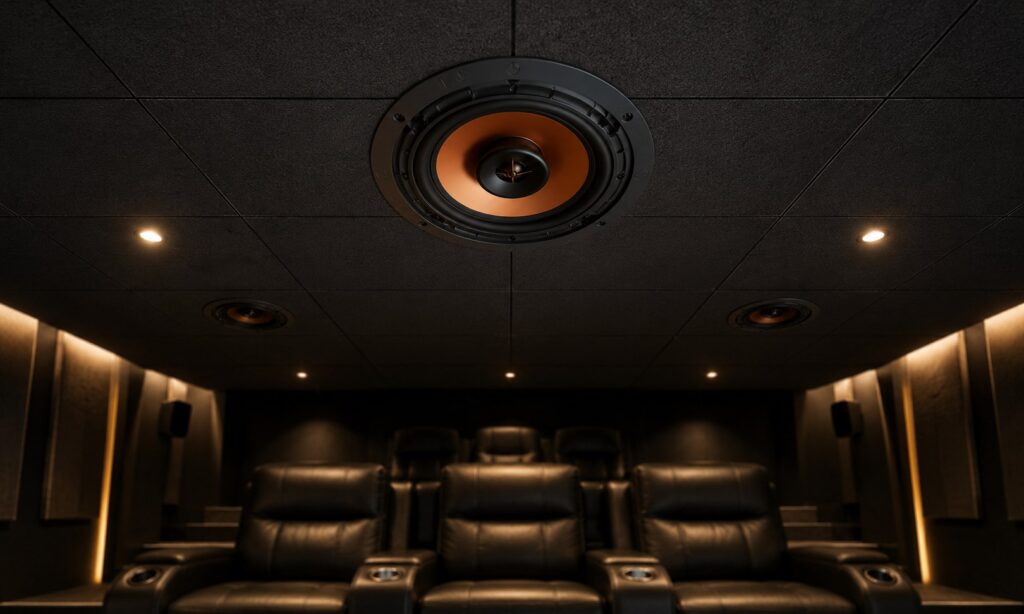
If your main speakers are Klipsch horn-loaded towers, Heritage series, Reference Premiere, or similar 97-100dB-sensitive designs, the CDT-5800-C II is the correct overhead channel match.
Pairing a 97 dB-sensitive main speaker with an 82dB ceiling speaker forces the AV receiver’s DSP to apply significant positive gain to the overhead channels. The amplifier hits thermal compression on the height channels while the mains barely break a sweat. The CDT-5800-C II closes that efficiency gap.
The Tractrix horn geometry around the 1-inch titanium tweeter is the differentiator. Controlled dispersion keeps high frequencies from scattering off the ceiling plane before reaching the listening position. Overhead rain, helicopters, and wide spatial effects land with greater separation and spatial precision than a competing speaker at this price that uses a basic pivoting dome tweeter. The 8-inch Cerametallic woofer on a pivoting mount allows you to angle the bass driver toward the seat as well.
The installation failure mode for this speaker is entirely avoidable and completely documented. The crossover PCB runs close to the dog-ear mounting screw path inside the housing. Overtightening, especially with a power drill on anything above the lowest clutch setting, flexes the plastic mounting ring inward.
That flex fractures the fiberglass PCB, cracking copper traces and creating intermittent static or complete signal loss. Repairs require hand-soldering jumper wires across the fractured traces and reinforcing the board with hot glue. Prevention requires hand-tightening only, or a drill set to its minimum clutch. Do not rush this step.
The horn-loaded treble is detailed and punchy for movie soundtracks. For extended music listening sessions, it becomes fatiguing; this is a characteristic of Klipsch’s sound signature across their product line, not a flaw specific to this model. For Atmos overhead effects on action content, it is outstanding.
Pros:
- High sensitivity matches horn-loaded bed layer speakers, preventing DSP gain-matching problems that cause overhead channel distortion at reference levels
- Tractrix horn delivers genuine controlled dispersion, keeping high-frequency energy directed at the listener rather than scattering across the ceiling plane
- 8-inch woofer and pivoting tweeter provide real physical aiming flexibility for non-standard room geometries
Cons:
- PCB fracture from overtightening is a documented failure across multiple production runs. Hand-tighten every screw without exception
- Horn-loaded tweeter fatigues during long music listening sessions; this speaker is optimized for dynamic impact, not extended two-channel listening
Buy this if: Your main speakers are high-efficiency horn-loaded designs and you need overhead channels that match their output capability without taxing the AV receiver’s DSP
Skip this if: You are building a music-first ceiling system or your installation timeline is tight, and you cannot afford to hand-tighten carefully
Price note: Approximately $400 per speaker on Amazon US as of May 2026.
Polk Audio RC80i, The Whole-Home Audio Standard for Good Reason
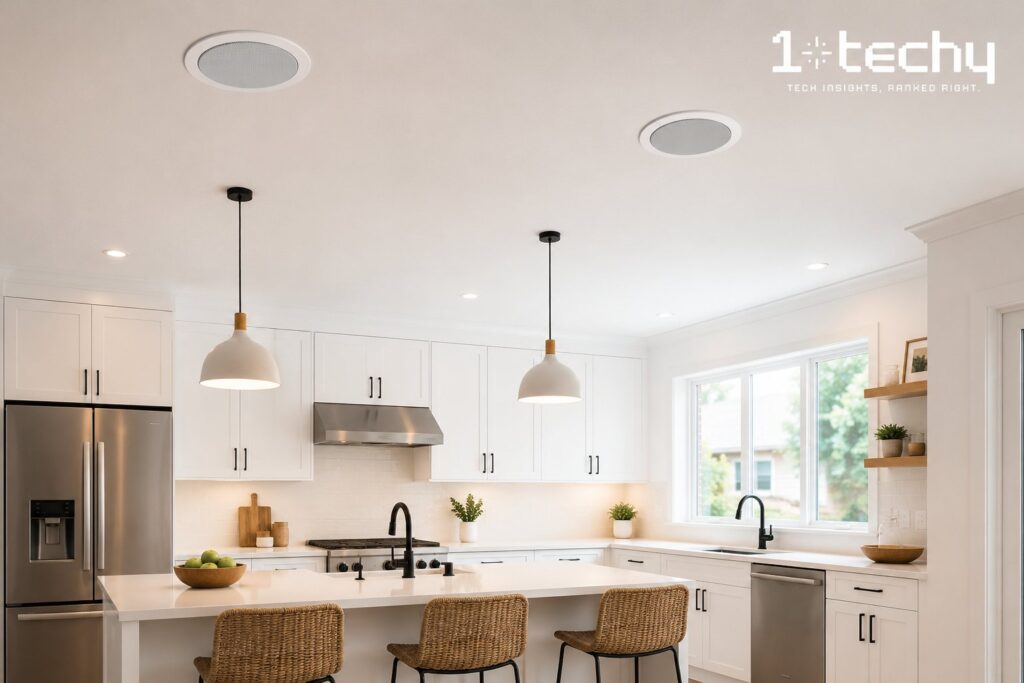
The RC80i is not a Dolby Atmos speaker. It does not try to be. What it is: a moisture-resistant, high-sensitivity, wide-dispersion ceiling speaker that belongs in kitchens, bathrooms, covered patios, and multi-zone distributed audio systems where the goal is ambient coverage, not spatial precision.
The 8-inch Dynamic Balance woofer and 0.75-inch pivoting silk dome tweeter deliver broad dispersion by design. When someone in the kitchen wants background music while cooking, they want the room filled evenly, not a sweet spot at the center island.
Wide dispersion serves that application correctly. It also explains why the RC80i is the wrong tool for Atmos height channels, where you specifically do not want diffuse overhead sound; you want discrete, directional spatial information.
If you are setting up a whole home audio system using a multi-zone amplifier that powers six or eight zones simultaneously, the RC80i’s high sensitivity means individual zones stay undistorted at normal listening levels without the zone amplifier running out of headroom. Budget a separate two-channel amplifier per room if you plan to push these hard in a larger open-plan space.
Two failure modes get blamed on this speaker in owner reviews, but originate elsewhere. The buzzing at high volume that multiple Amazon reviewers attribute to blown drivers is almost always an underpowered AV receiver clipping the signal.
A receiver that runs out of voltage headroom sends a squared-off, distorted waveform downstream; it sounds identical to a mechanical driver problem from the listening chair, but upgrading to a dedicated outboard amplifier resolves it completely.
The grille rattle against the trim ring at certain bass frequencies is a separate mechanical issue: bending the grille mesh edges slightly outward before clipping it in creates a tighter friction fit and eliminates the vibration.
Pros:
- Moisture-resistant construction is tested in bathrooms, kitchens, and covered outdoor areas, a functional feature rather than a marketing claim
- High sensitivity allows low-wattage multi-zone amplifiers to drive multiple rooms simultaneously without distortion
- Wide dispersion fills rooms evenly for ambient listening applications where positional accuracy is not the priority
Cons:
- Not appropriate for Dolby Atmos height channel positions, wide dispersion actively degrades the spatial precision Atmos requires
- Grille rattle at low-frequency resonance nodes requires a manual adjustment to the mesh fit before the first listening session
Buy this if: You are wiring a multi-room distributed audio system and need reliable ceiling speakers at $35-50 per unit that handle ambient listening in variable humidity environments
Skip this if: You want these for Atmos overhead channels or for high-volume critical listening in a dedicated theater space
Price note: Approximately $35 to $50 per speaker on Amazon US as of May 2026. Commonly sold in pairs.
KEF Ci200RR-THX, When the Listening Area Is Wide, and the Budget Is Not the Constraint
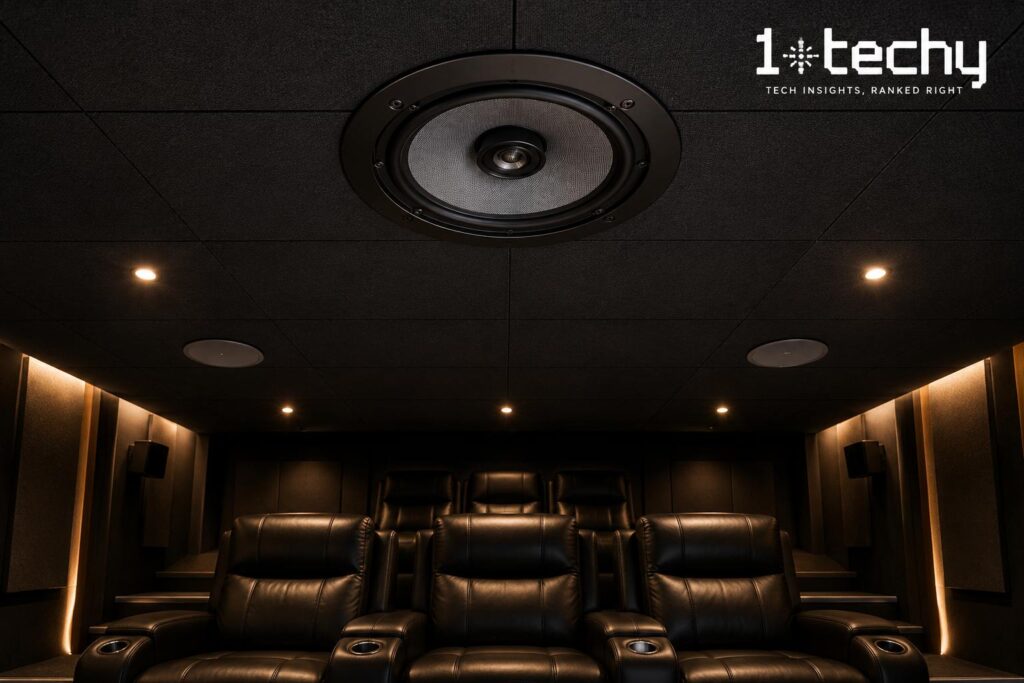
At $1,000 per speaker, the KEF Ci200RR-THX is not competing with the RSL C34E MKII. It is competing with the argument that a ceiling speaker can sound as accurate as a freestanding cabinet speaker across a wide multi-row seating area. The Ci200RR-THX makes that argument convincingly.
The Uni-Q driver places the 1.5-inch vented aluminum dome tweeter concentrically inside the 8-inch aluminum woofer at the same acoustic center. No other design at this price point does this. The consequence is that the off-axis frequency response measured at 45 degrees, the angle at which most Atmos height channel listeners actually sit, is nearly identical to the on-axis response.
Independent Klippel Near-Field Scanner measurements published by the audio measurement community confirm the directivity remains uniform and flat out to 50 degrees off-axis, with only a minor shortfall above 10kHz. For a room with a wide seating arrangement, every listener hears the same Atmos overhead imaging.
One integration issue requires planning. The Ci200RR-THX drops to a 4-ohm impedance dip around 3kHz. Entry-level AV receivers specify wattage at 8 ohms; their current delivery at 4 ohms is often 40-50% lower. Under high-SPL demands, the receiver clips. A dedicated high-current outboard amplifier for the overhead channels, the Emotiva BasX line, or similar, is not optional for this speaker in a demanding Atmos application. Budget accordingly.
The efficiency gap also matters if your bed layer speakers are Klipsch or other horn-loaded designs. The KEF runs 10dB or more efficiently than a horn-loaded LCR at the same input power. Your AVR’s DSP can apply positive gain to compensate, but it pushes the KEF’s ceiling channels toward their thermal limits before the mains approach theirs. Matching efficiency between your height channels and your bed layer matters more than matching driver materials.
Pros:
- Uni-Q coaxial geometry maintains a consistent frequency response at wide off-axis angles, critical for rooms with multiple seating rows, where every seat needs accurate overhead imaging
- THX certification confirms the speaker passes cinema-reference SPL and distortion thresholds under independent test conditions, not just manufacturer claims
- Tangerine waveguide controls high-frequency dispersion uniformly without requiring a physical driver aiming
Cons:
- 4-ohm impedance dip requires high-current outboard amplification; entry-level AV receivers clip under sustained reference-level demands
- 10dB or greater efficiency gap versus horn-loaded bed layer speakers creates DSP gain-matching challenges in mixed-brand home theater systems
Buy this if: You have a dedicated acoustically treated theater, high-current separate amplification, and a wide seating area that exposes the off-axis limitations of every other speaker on this list
Skip this if: Your AV receiver is an entry-level model or your bed layer speakers are high-efficiency horn-loaded designs that will outpace the KEF’s overhead output capability
Price note: Approximately $1,000 per speaker on Amazon US as of May 2026.
Micca M-8C, An Honest Entry Point With Known Limits
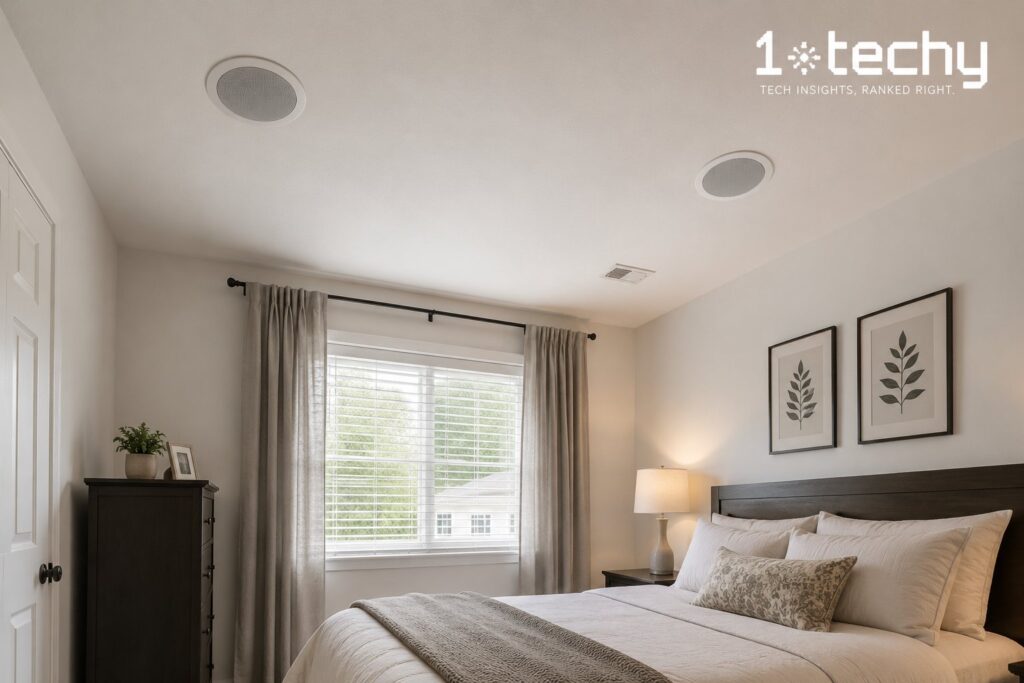
The Micca M-8C costs $120 for a pair. That number sets the expectations correctly. This is the right first speaker for someone testing whether Atmos height channels improve their listening experience before committing to a permanent install, not the right speaker for a home theater where these will run daily at moderate to high volume.
The 8-inch poly woofer and 1-inch pivoting silk dome tweeter perform adequately for speech and mid-frequency music at low to moderate listening levels. Human psychoacoustics are measurably less sensitive to tonal accuracy in sources positioned directly overhead, which is why budget ceiling speakers in Atmos height positions do not need to be perfect; they need to contribute spatial presence convincingly. In a small bedroom application at 40-60% volume, the M-8C does this.
The failure mode is specific and documented across long-term owner reports. The voice coil on the woofer does not have sufficient thermal mass to dissipate heat during sustained high-current output. After roughly 12 to 18 months of regular use at 60% volume or above, the voice coil begins to delaminate from thermal stress.
It physically contacts the magnetic gap during driver excursion and produces a mechanical buzz. At that point, the driver needs replacement; there is no adjustment or cleaning fix. Driving the M-8C from an underpowered receiver that clips produces the identical buzzing symptom from a different cause. Clean amplification extends the M-8C’s service life considerably.
For hardwired architectural speaker applications where you need something more durable long-term, comparing ceiling speakers against in-wall speaker options is worth doing before running cable. In-wall designs benefit from a more controlled cavity volume that reduces the bass loading variability that stresses budget drivers.
Pros:
- $120 per pair is the lowest accessible price point in architectural ceiling audio from a recognized brand with consistent manufacturing quality
- Pivoting tweeter allows basic directional aiming toward the listening position without requiring an angled-baffle speaker housing
- Adequate performance for entry-level Atmos experimentation and light-use ambient listening in small rooms
Cons:
- Voice coil thermal delamination is a consistent failure mode under sustained moderate-to-high SPL use; expect driver replacement within one to two years in demanding applications
- Grille mesh rattles against the trim ring at certain low-frequency nodes until manually adjusted before installation
Buy this if: You want to experiment with Dolby Atmos height channels in a small, low-demand room before committing to a permanent wiring investment
Skip this if: You plan to drive these at regular moderate-to-high volume or need ceiling speakers that will hold up in a dedicated theater used daily
Price note: Approximately $120 per pair on Amazon US as of May 2026.
Comparison Table
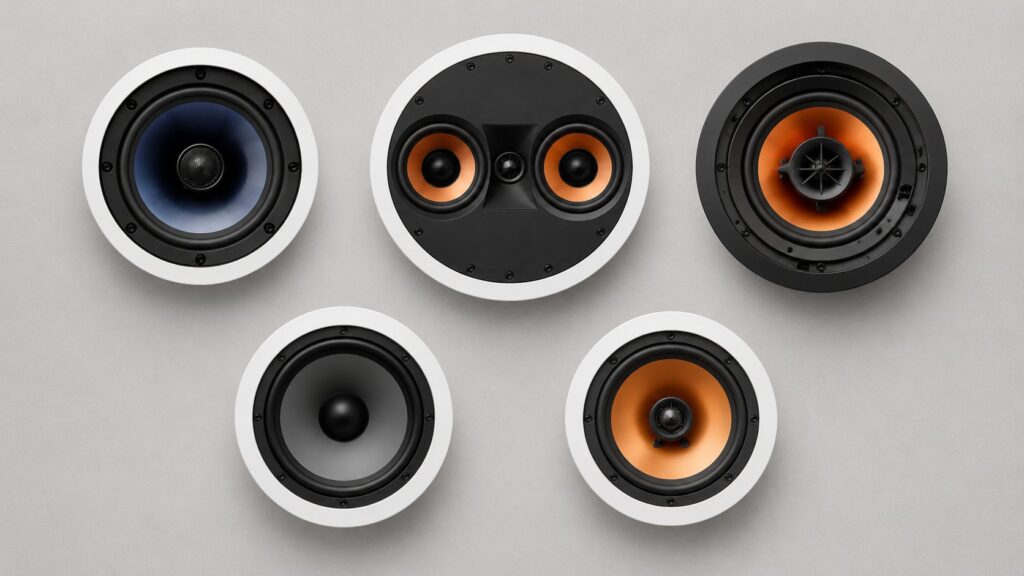
| Product | Driver Layout | Power (RMS) | Directivity Method | Best Use Case | Rating |
|---|---|---|---|---|---|
| RSL C34E MKII | Dual 4.5″ MTM + 22mm dome | 80W | 15° fixed-angle baffle | Dolby Atmos height channels | 9.0/10 |
| Klipsch CDT-5800-C II | 8″ Cerametallic + 1″ Ti Tractrix Horn | 75W | Pivoting Tractrix horn + pivoting woofer | High-SPL Atmos, horn-matched systems | 8.0/10 |
| Polk Audio RC80i | 8″ Dynamic Balance + 0.75″ silk | 100W | Wide dispersion, pivoting tweeter | Whole-home distributed audio | 7.5/10 |
| KEF Ci200RR-THX | 8″ Alum Woofer + 1.5″ Uni-Q coaxial | 150W | Tangerine waveguide, coaxial geometry | Reference home theater | 9.5/10 |
| Micca M-8C | 8″ poly + 1″ silk dome | 80W | Basic pivoting tweeter | Budget / entry-level Atmos | 6.5/10 |
RMS wattage figures are used throughout. Peak power specs are not listed; they overstate real-world handling capability and are used for marketing purposes only.
What to Avoid: Buyer Mistakes That Ruin Good Installations
Skipping the amplifier current check before buying the speakers. A ceiling speaker rated at 4 ohms needs an amplifier that delivers current at 4 ohms, not one specified at 8 ohms with a footnote. Entry-level AV receivers lose 40-50% of their stated wattage when impedance drops to 4 ohms. The KEF Ci200RR-THX exposed this clearly in testing. If your receiver costs under $600, run an 8-ohm load or budget a separate amplifier for the overhead channels.
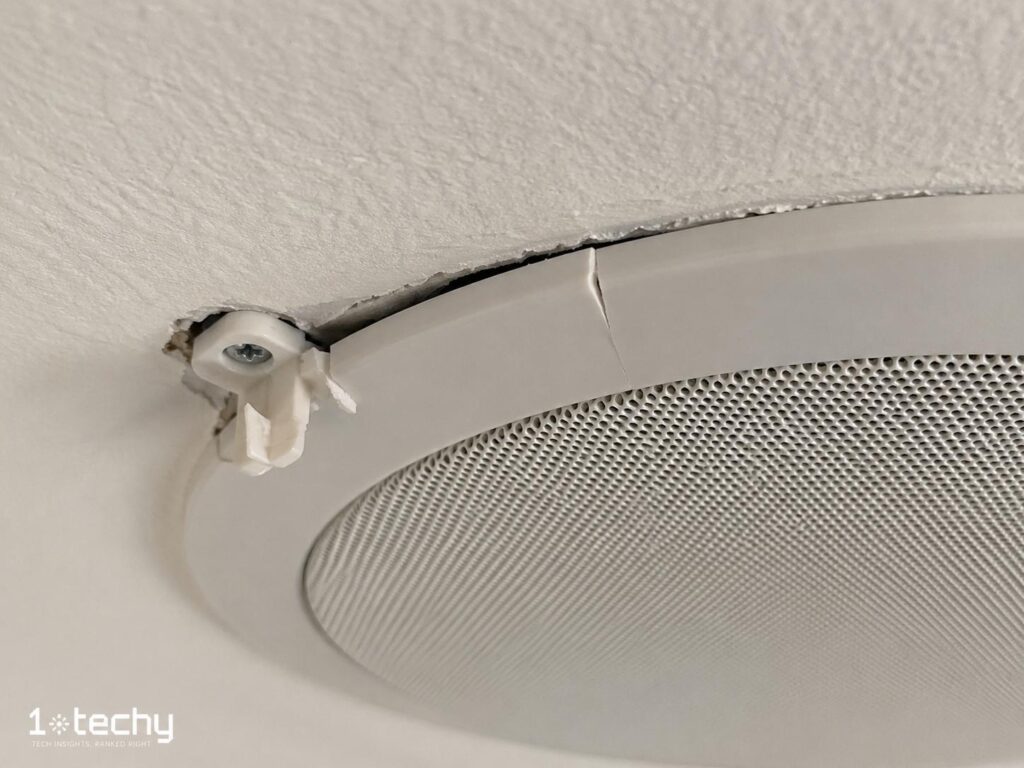
Freehand-cutting the ceiling hole instead of using the template. The RSL C34E MKII’s mounting tabs barely clear the basket perimeter. An extra quarter inch of hole diameter leaves the speaker unsecured. It sits in the ceiling, vibrates on bass transients, and produces a rattle that sounds exactly like a driver failure. Cut with the template. Every ceiling speaker ships with one.
Using a power drill at standard torque to mount the Klipsch CDT-5800-C II. The PCB fracture failure in this model is avoidable and entirely the result of overtightening. The mounting screw path runs adjacent to the crossover board. Drill torque flexes the housing, cracks the fiberglass board, and severs copper traces. Result: intermittent static or a dead channel. Hand-tighten only. This takes three minutes longer than using a drill. It prevents a repair that takes ninety minutes plus soldering tools.
Lowering the crossover below what the room calibration recommends. If auto-calibration software sets a ceiling speaker’s crossover at 100Hz after measuring the ceiling cavity resonance, do not override it to 60Hz because you want more bass from the overheads. Below the calibrated rolloff, the driver operates outside its linear range, distortion increases, and thermal stress on the voice coil rises. Ceiling speakers are not subwoofers and should not be treated as such.
Buying Guide, The Two Decisions That Actually Matter
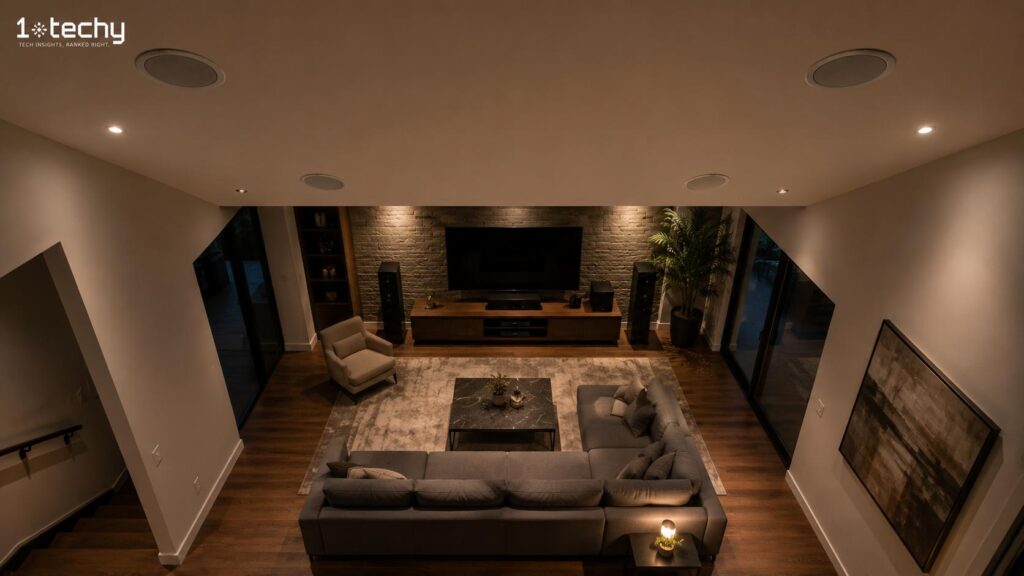
Distributed audio speakers versus Atmos height channel speakers. They look identical in every product photo. They are not the same application. Distributed audio ceiling speakers, like the Polk RC80i, are optimized to fill a room evenly with ambient sound, firing downward with wide dispersion.
That diffuse coverage is correct for a kitchen playing background music. For Dolby Atmos overhead channels, wide dispersion defeats the purpose entirely. Dolby’s object-based audio system requires directional spatial information from the overhead channels; diffuse sound prevents the brain from localizing anything overhead, which eliminates the immersive effect.
Understanding how many watts you need for ceiling speakers in your specific setup, whether a distributed multi-zone amplifier or a dedicated two-channel amp, determines whether your equipment can deliver clean power to each room or whether you will chase clipping distortion across the system.
Coaxial driver versus separate tweeter layout. A true coaxial design like the KEF Ci200RR-THX places the tweeter and woofer at the same acoustic center. The result is that the off-axis frequency response, the response you hear from a seat that is not directly below the speaker, matches the on-axis response.
Speakers with separate tweeter and woofer drivers mounted at different physical locations create comb filtering at the crossover frequency when you are not sitting on-axis. For a single-seat setup, a pivoting tweeter handles this adequately. For a wide room with two or three seating rows, a coaxial geometry is worth the additional cost.
If you are weighing ceiling speakers against in-wall speakers for front left, center, and right channels or surrounds, in-wall designs generally benefit from a more controlled cavity environment than the variable joist bay above a ceiling. Ceiling cavity size, insulation density, and air leaks to adjacent rooms all affect bass extension and driver resonance in ways that in-wall cavities are less exposed to.
Final Recommendation
The RSL C34E MKII is the right buy for most people building a Dolby Atmos system. At $149 per speaker with a 15-degree angled baffle and MTM driver layout, it outperforms everything else in its price range when the crossover is set correctly, and the baffle is aimed at the primary seating row.
If your main speakers are high-efficiency horn-loaded designs, buy the Klipsch CDT-5800-C II and hand-tighten every mounting screw.
If you are wiring a whole-home distributed system and need reliable ceiling speakers at under $50 per unit in kitchens, bathrooms, or covered patios, the Polk RC80i is what professional installers reach for.
The Micca M-8C is worth considering only if you are testing the Atmos concept in a low-demand bedroom before committing wire to the ceiling permanently.
The KEF Ci200RR-THX is for the buyer with a dedicated theater, separate high-current amplification, and a seating arrangement wide enough that off-axis frequency response would be audible with any other speaker on this list.
FAQs about Ceiling Speakers
Is the RSL C34E MKII better than the Klipsch CDT-5800-C II for Dolby Atmos?
For tonal accuracy and off-axis performance at standard listening levels, yes. The RSL’s angled MTM baffle delivers measured directivity that the Klipsch does not match at the same price. The Klipsch produces more output and matches more efficiently with high-sensitivity horn-loaded bed layer speakers, which prevents DSP gain problems in mixed-brand systems. Choose the RSL for tonal accuracy; choose the Klipsch when you need overhead channel sensitivity that matches your mains.
What does the MTM configuration in ceiling speakers actually do?
MTM stands for Midwoofer-Tweeter-Midwoofer. The tweeter is flanked by two identical woofers, which widens horizontal dispersion and improves off-axis frequency response compared to a single woofer-plus-tweeter design. In a ceiling application, horizontal dispersion matters more than vertical because listeners sit off to the sides rather than directly below. The RSL C34E MKII uses this configuration alongside its angled baffle to deliver directional accuracy that single-driver budget ceiling speakers cannot match.
Are ceiling speakers good for Dolby Atmos height channels?
Yes, when the right speaker is selected and installed correctly. Dolby specifies height channels at 30 to 55 degrees off-axis relative to the primary listening position. Speakers designed for distributed audio, with flat-firing wide dispersion, do not satisfy this geometry. Speakers with angled baffles like the RSL C34E MKII or coaxial designs like the KEF Ci200RR-THX deliver the directional spatial information Atmos requires. The speaker type, not ceiling placement alone, determines whether the Atmos experience works.
Why do ceiling speakers buzz at high volume?
Three distinct causes produce identical symptoms. Grille rattle against the trim ring at certain bass frequencies is a mechanical fit issue, resolved by tensioning the grille mesh edges before installation. Voice coil thermal delamination, documented in the Micca M-8C after sustained high-SPL use, is a driver failure from heat stress. Amplifier clipping from an underpowered receiver is the most common cause of Polk RC80i complaints; the receiver runs out of voltage headroom and sends a distorted waveform downstream. Upgrading to a dedicated outboard amplifier resolves clipping distortion completely and prevents it from being mistaken for a speaker defect.
How many ceiling speakers do I need for a room?
For Dolby Atmos, a minimum of two overhead speakers creates a 5.1.2 system. Four overhead speakers deliver the full 5.1.4 experience in medium to large rooms. For whole-home distributed audio, professional installers size at one speaker per 50 to 75 square feet of floor area for ambient coverage at normal listening levels, with pairs of speakers rather than single units where room geometry permits.
Prices verified May 2026. Amazon pricing fluctuates with sales and stock availability. Confirm the current listing price before purchasing.


