
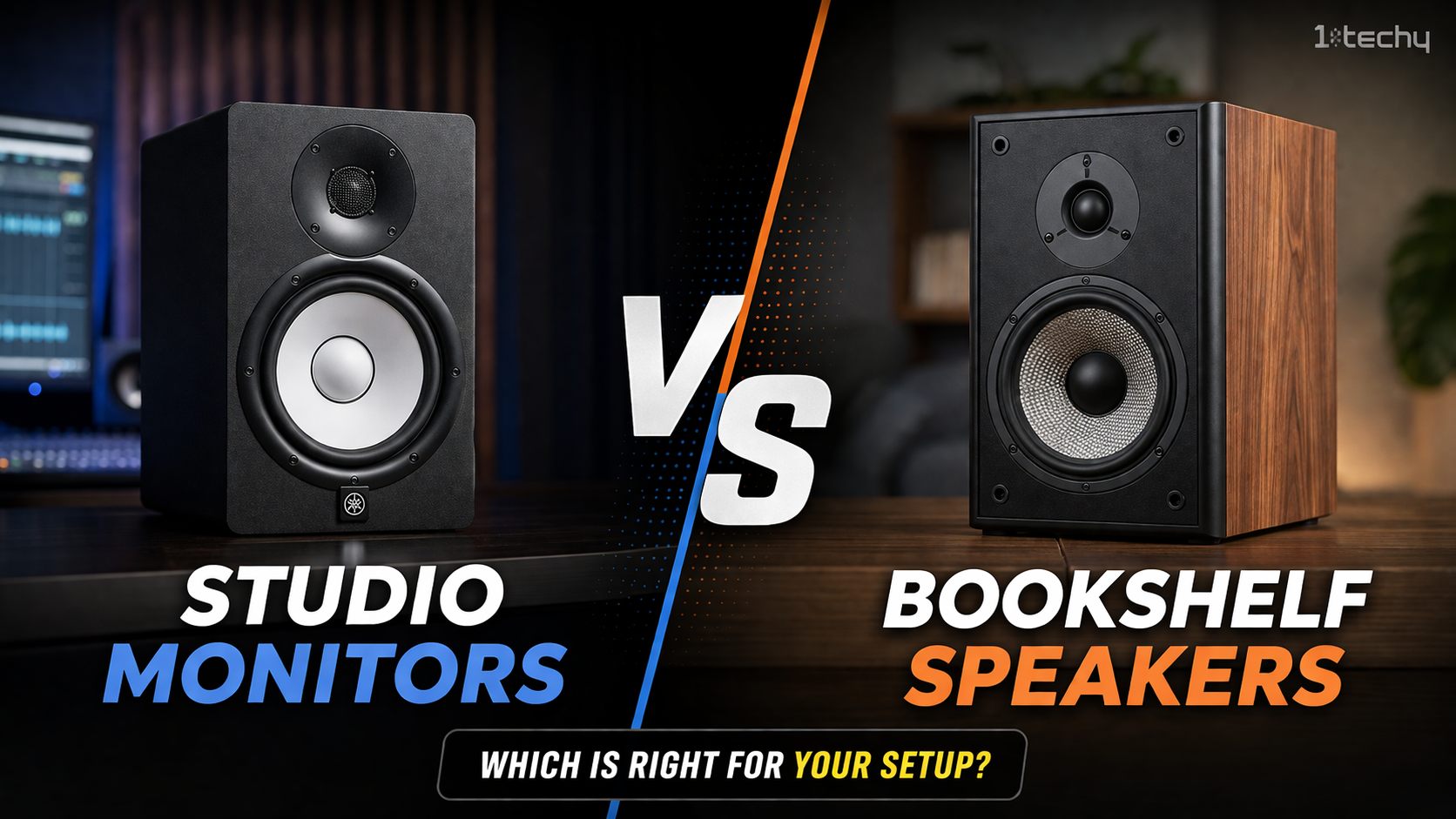
You search for the best desk audio, and suddenly, every forum says something completely different. Both options look like identical wooden boxes, but they behave very differently in real use.
Buying the wrong pair leads to a frustrating experience where your music either sounds totally lifeless or horribly muddy. This guide breaks the decision down simply so you can pick the right gear studio monitors vs bookshelf speakers, without wasting money.
Quick Answer: The Real Difference
Do studio monitors perform better than bookshelf speakers?
Short answer: No, they just do a different job.
Studio monitors are better for audio production and precise editing. They focus on absolute accuracy. You typically use them for mixing tracks or cutting video timelines.
Bookshelf speakers are better for general entertainment. They focus on rich, enjoyable audio. You typically use them for blasting playlists, watching movies, or playing games.
If your priority is hearing the absolute truth in a recording, choose studio monitors.
If your priority is relaxing and having fun, choose bookshelf speakers.
What Are Studio Monitors?
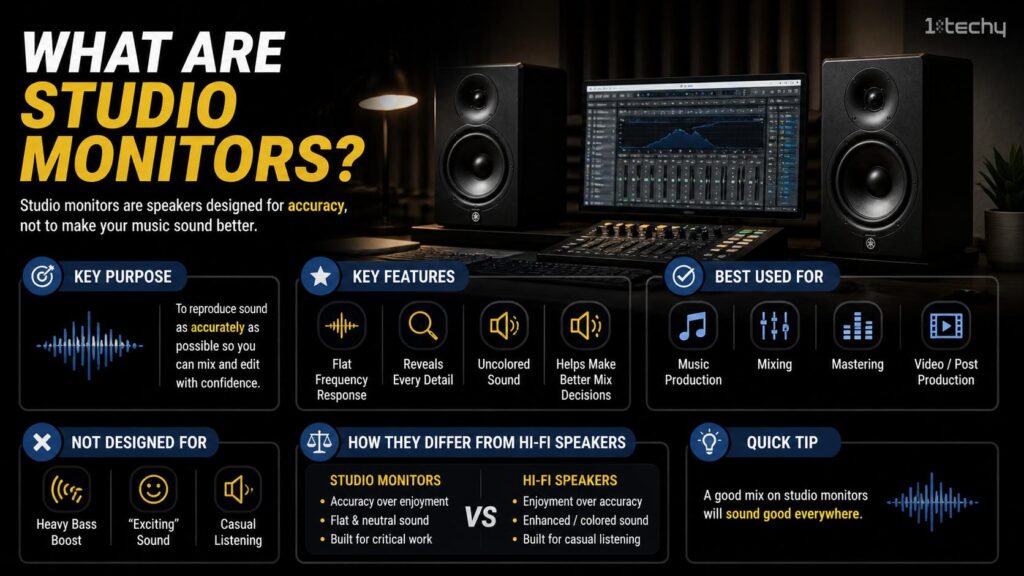
A studio monitor is a specialized tool built for audio professionals. These units deliver what engineers call a flat frequency response. That means the internal components do not artificially boost the bass or sharpen the treble.
You hear the exact audio file, complete with all its flaws. Audio producers rely on this strict accuracy to fix mistakes in a mix. Furthermore, these units are meant for near-field listening. Sitting about three feet away creates the perfect sweet spot for detailed sound.
What Are Bookshelf Speakers?
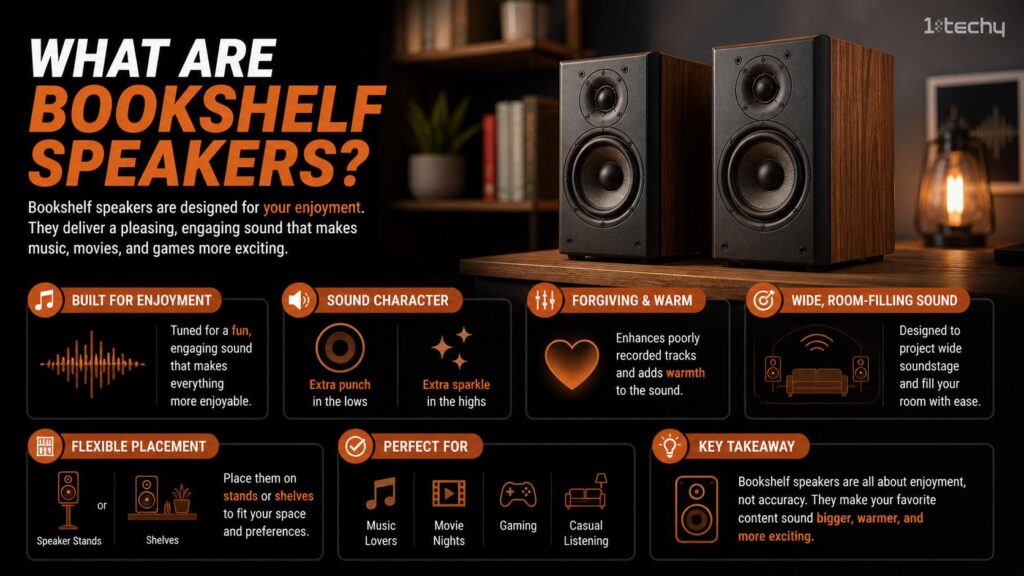
These speakers exist entirely for your enjoyment. Manufacturers build bookshelf speakers with tuned sound profiles. They usually add a little extra punch to the low frequencies and extra sparkle to the highs. This tuning hides the imperfections in poorly recorded songs and makes everything feel warm. You place them on stands or shelves to project wide, room-filling sound.
Side-by-Side Comparison
| Feature | Studio Monitors | Bookshelf Speakers |
| Core Use | Production and mixing | Entertainment and media |
| Sound/Performance | Flat, accurate, analytical | Enhanced, warm, colored |
| Setup | Active (plug into wall) | Mostly passive (need amplifier) |
| Best For | Desks and near-field | Living rooms and home theaters |
Key Differences Explained (Studio Monitors vs Bookshelf Speakers )
1. Performance and Output Difference
Studio monitors fight against artificial enhancement. They expose bad audio quality more clearly. If a YouTube video has terrible background hiss, a monitor makes sure you hear it. Bookshelf options do the opposite.
They act like a comfortable filter, smoothing out rough edges to make your listening session pleasant.
Do studio monitors sound better for music? Short answer: Not for casual listening. They sound more accurate, but they often feel less exciting than bookshelf speakers.
2. Purpose (Use Case)
Think of monitors as diagnostic equipment. You buy them to dissect podcasts, balance instruments, or edit dialogue.
Bookshelf models act more like a private concert. Buying them makes sense when you want to kick back and lose yourself in a massive gaming world.
3. Setup & Usability
Almost all modern monitors feature an active design. Amplifiers live directly inside the speaker cabinets.
You just plug them straight into a power outlet and your audio interface. Most traditional bookshelf units use a passive design. That setup requires you to buy a separate external amplifier and run bare speaker wire across your desk.
4. Environment (Where it works best)
Placement dictates everything about audio quality. Engineers build monitors to shoot a tight, focused beam of sound directly at your ears from a short distance.
Bookshelf designs push audio outward to fill large spaces. Sitting too close to a massive pair of passive speakers often results in a blurry, unfocused stereo image.
Which One Should You Choose?
Choose Studio Monitors if:
- You produce music or edit video for a living.
- Your desk is your primary workspace.
- Hearing the exact details of a raw recording matters to you.
Choose Bookshelf Speakers if:
- You mainly play video games and watch movies.
- Your goal is a fun, heavy, and relaxing sound.
- You want to fill an entire room with music.
Real-World Scenarios
Gaming
Bookshelf speakers completely dominate here. Explosions feel massive, and engine noises sound heavy thanks to the artificially boosted bass. Studio monitors often make action games feel flat and boring.
Music and Media
Bookshelf units take the win for casual enjoyment. They sound fuller even without a subwoofer. At low volume, studio monitors feel slightly thin because they refuse to boost the low-end frequencies.
Work and Production
Monitors are absolutely mandatory for this category. Mixing a track requires speakers that do not lie to your ears. A song mixed on heavily colored speakers will sound terrible when played in a car or on a phone.
Best for Desktop Setup
Space becomes your biggest enemy when building a desk rig. Monitors naturally fit this environment perfectly because they are active and designed for close-range listening. You can definitely use standard hi-fi gear if you prefer that warmer tone. Knowing how to set up bookshelf speakers for desktop environments saves you from a muddy listening experience. You need a compact desktop amp and proper foam isolation pads to prevent your table from rattling.
Studio Monitors vs Computer Speakers
Many beginners start with cheap plastic multimedia units. Moving up to a set of monitors will completely shock your ears. Professional gear provides massive clarity and distinct instrument separation that basic PC setups cannot match.
If you are not ready to spend $300 right now, checking out the 5 Best Computer Speakers Under $100 is a smart middle ground. That serves as a great entry-level path before dropping serious cash on professional tools.
2.1 vs 2.0 Systems
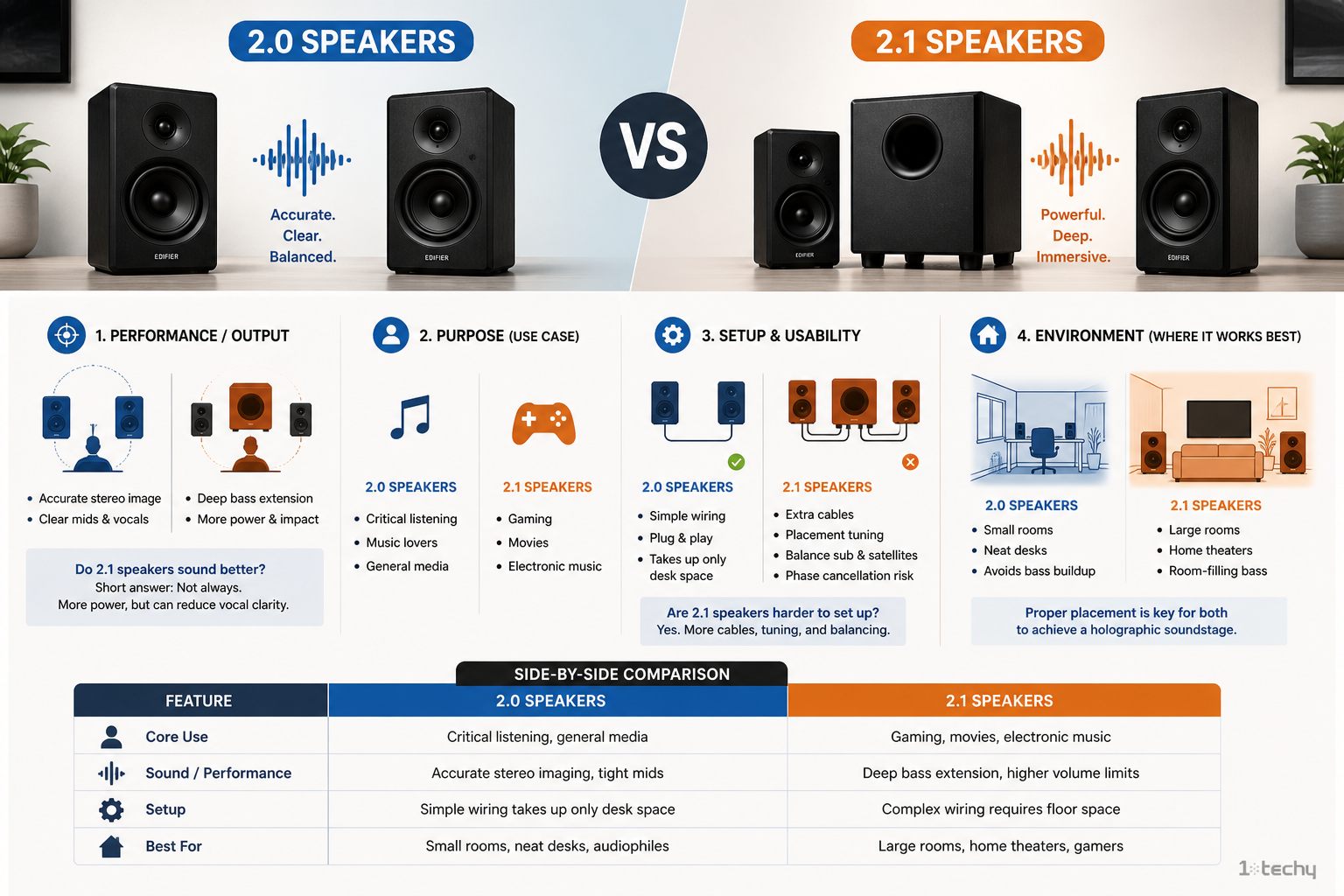
Most standard pairs arrive as a 2.0 setup, meaning two speakers and zero subwoofers. Monitors specifically lack extreme low-end punch because they aim for accuracy. You will eventually want a sub if you love heavy bass drops. Deciding between 2.1 vs 2.0 speakers, which is better, comes down to your room size and your neighbors. A subwoofer adds incredible depth to movies, but it will easily vibrate right through apartment walls.
Common Mistakes People Make
- Buying monitors just for casual music. People assume “professional” automatically means better. They end up highly disappointed when their favorite Spotify playlists sound boring.
- Ignoring room acoustics. Putting high-end monitors in a bedroom with bare walls destroys the flat response. Echoes ruin the precise audio you just paid for.
- Choosing solely based on brand hype. Slapping a famous logo on a cheap box does not change physics. Always check the frequency response chart before pulling out your credit card.
Summary
- Studio Monitors = Highly accurate, flat sound for audio work and desk use.
- Bookshelf Speakers = Fun, tuned sound for pure entertainment and room-filling audio.
Choose based on whether you are working or relaxing at your desk.
FAQs
Are studio monitors better than bookshelf speakers?
No, they serve a totally different purpose. Monitors work best for professional audio analysis. Bookshelf units work best for casual entertainment.
Can you use studio monitors for everyday listening?
Yes, many people love the extreme clarity they offer. Just be prepared for poorly mixed YouTube videos to sound very harsh.
Are bookshelf speakers good for music production?
No, they are generally terrible for mixing. Their boosted frequencies trick your ears, causing you to make the wrong editing decisions.
Do studio monitors need an amplifier?
Most modern monitors do not need an external amp. They operate as active speakers with amplifiers built directly into the housing.
Which is better for gaming?
Bookshelf speakers easily provide a better gaming experience. The tuned, colorful sound profile makes virtual environments feel highly immersive.


