
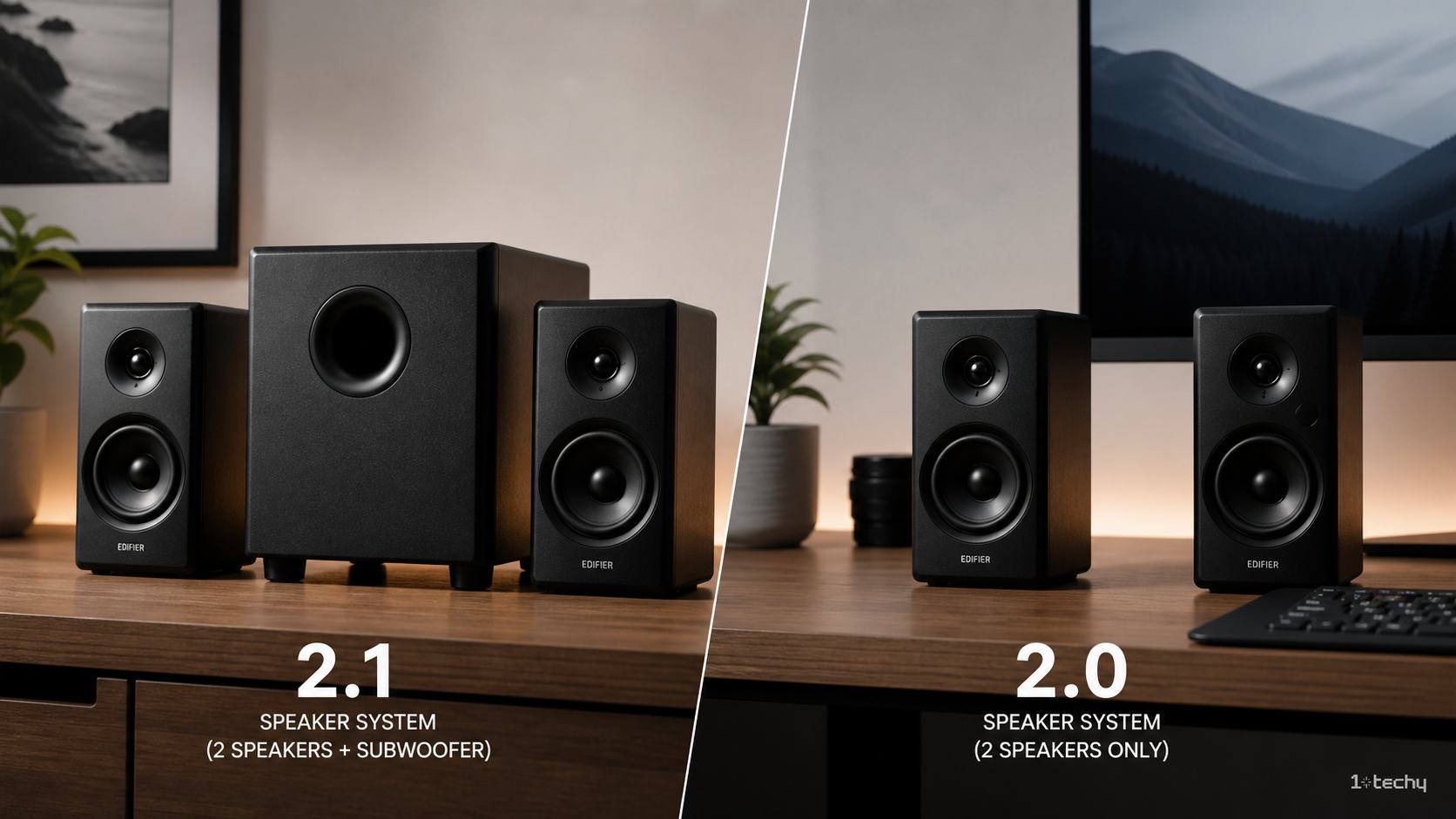
You search for desk speakers online, and suddenly, every audio forum says something completely different.
Both options look similar, but they behave very differently in real use. Wrong choices lead to a bad experience, like wasting desk space on a muddy subwoofer or missing out on bass impact entirely.
This guide breaks down 2.1 vs 2.0 speakers in a simple way so you can pick the right one without wasting money.
Quick Summary: 2.0 vs 2.1 Speakers at a Glance
Do 2.1 speakers perform better than 2.0?
Short answer: It depends entirely on your main activity.
2.0 systems are better for music clarity and tight desk spaces.
2.1 setups are better for gaming, movies, and feeling low frequencies.
If your priority is accurate sound reproduction, choose 2.0.
If your priority is deep bass impact, choose 2.1.
Understanding the Architecture
What is a 2.0 System?
A 2.0 setup consists of a left and right channel. It focuses entirely on stereo purity. You get two boxes sitting on your desk, handling the entire frequency range.
What is a 2.1 System?
This setup adds a dedicated subwoofer for the Low-Frequency Effects channel. The satellite speakers handle the highs and mids. The sub pushes the deep bass.
Key Differences 2.1 vs 2.0 Speakers
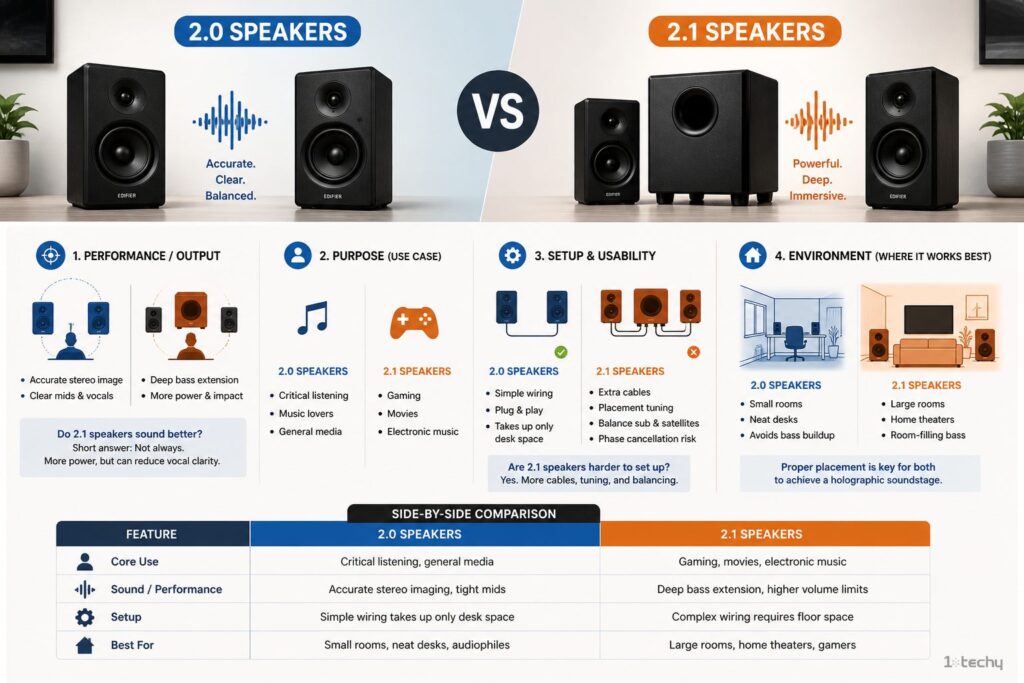
1. Performance / Output Difference
A 2.0 pair creates a highly accurate stereo image. You hear instruments exactly where the producer placed them. A 2.1 system shifts the heavy lifting of bass away from the smaller desk speakers.
To avoid the muddy transition between your satellites and subwoofer, you need to understand the crossover frequency where the audio signal splits. Poor crossover integration in cheap 2.1 systems often creates a gap in the lower midrange vocals.
Do 2.1 speakers sound better than 2.0?
Short answer: Not always.
They sound more powerful because of the subwoofer, but that can reduce vocal clarity.
2. Purpose (Use Case)
Music lovers almost universally prefer two high-quality channels. For those who prefer data over marketing fluff, checking frequency response graphs on sites like AudioScienceReview reveals the true neutrality of a 2.0 system.
Gamers usually want the physical rumble of engines and explosions. A dedicated subwoofer delivers that physical sensation much better than a standard pair of bookshelf boxes.
3. Setup & Usability
Managing a 2.0 pair is simple. You just run a single cable from your PC to the primary unit. Adding a subwoofer introduces extra wiring and requires floor space near a power outlet.
It also forces you to balance the volume levels between the sub and the satellites manually. Phase cancellation is another hurdle. If your sub and speakers push air at different times, your bass might literally disappear.
Are 2.1 speakers harder to set up?
Yes.
They require extra cables, placement tuning, and balancing between the sub and satellites.
4. Environment (Where 2.1 vs 2.0 speakers work best)
Small rooms often ruin heavy bass. Low frequencies bounce off walls and create muddy echoes known as room modes. A solid 2.0 pair avoids overloading a small bedroom. Large home offices benefit more from the room-filling power of a separate subwoofer. Whether you choose 2.1 or 2.0, proper speaker placement is what creates that holographic soundstage.
Side-By-Side Comparison
| Feature | 2.0 Speakers | 2.1 Speakers |
| Core Use | Critical listening, general media | Gaming, movies, electronic music |
| Sound/Performance | Accurate stereo imaging, tight mids | Deep bass extension, higher volume limits |
| Setup | Simple wiring takes up only desk space | Complex wiring requires floor space |
| Best For | Small rooms, neat desks, audiophiles | Large rooms, home theaters, gamers |
Real-World Scenarios
Gaming
Explosions and engine noises require a dedicated subwoofer to feel realistic. A 2.1 system is designed for this exact purpose. At low volume, 2.0 feels slightly thin when playing games with heavy ambient noise.
Music / Media
Acoustic tracks, jazz, and vocal podcasts rely heavily on midrange clarity. A 2.0 pair sounds fuller even without a subwoofer when listening to vocals. A good 2.0 setup exposes bad audio quality more clearly than a bass-heavy 2.1 rig.
Work / Production
Video editing requires neutral audio so you can mix levels accurately. Bass-heavy setups artificially inflate the low end. You will create better video mixes using flat-response 2.0 studio monitors.
The Technical Gap: The 2.2 Upgrade
Most guides ignore the next step up. Audio enthusiasts are increasingly moving toward dual small subwoofers, known as a 2.2 channel setup. Placing two smaller subs on opposite sides of a room solves uneven bass distribution. This gives you perfectly even bass no matter where you sit.
How 2.0 and 2.1 Speakers Actually Work
A 2.0 system sends all frequencies through two speakers. Each speaker handles bass, mids, and highs together. A 2.1 system splits this job.
The main speakers handle mids and highs, while the subwoofer handles low frequencies. This separation creates more bass impact but can introduce imbalance if not tuned properly.
Optimizing Your Workflow (Hardware Ecosystems)
Before finalizing your audio chain, ensure your source output is optimized. For more on improving your digital workspace, if you’re still using basic setups, this guide on Best Computer Speakers Under $100 shows what you can expect before upgrading, and Studio Monitors vs Bookshelf Speakers, which pair perfectly with a high-fidelity speaker setup.
Summary
[2.0 Speakers] = Clean wiring and accurate sound for music lovers.
[2.1 Speakers] = Heavy bass impact and physical immersion for gamers.
Choose based on your available floor space and whether you prioritize vocal clarity or deep rumbles.
FAQs
Is 2.1 better than 2.0?
It is not inherently better. A $200 pair of 2.0 monitors will sound significantly cleaner than a $200 2.1 bundle. The budget goes entirely into two high-quality drivers rather than being split three ways.
Can you use 2.0 speakers for gaming?
Yes. High-end bookshelf models produce surprising amounts of bass. You will hear enemy footsteps clearly because the midrange is not overpowered by muddy low frequencies.
Is 2.1 good for small rooms?
Often, no. Large subwoofers in tight spaces cause bass waves to bounce rapidly off walls. This creates a booming, headache-inducing sound. Stick to an accurate two-channel setup if your room is under 150 square feet.
Do you need an external amp?
Most desktop options are active, meaning the amplifier is built inside the cabinet. You only need an external amplifier if you buy passive speakers.


