
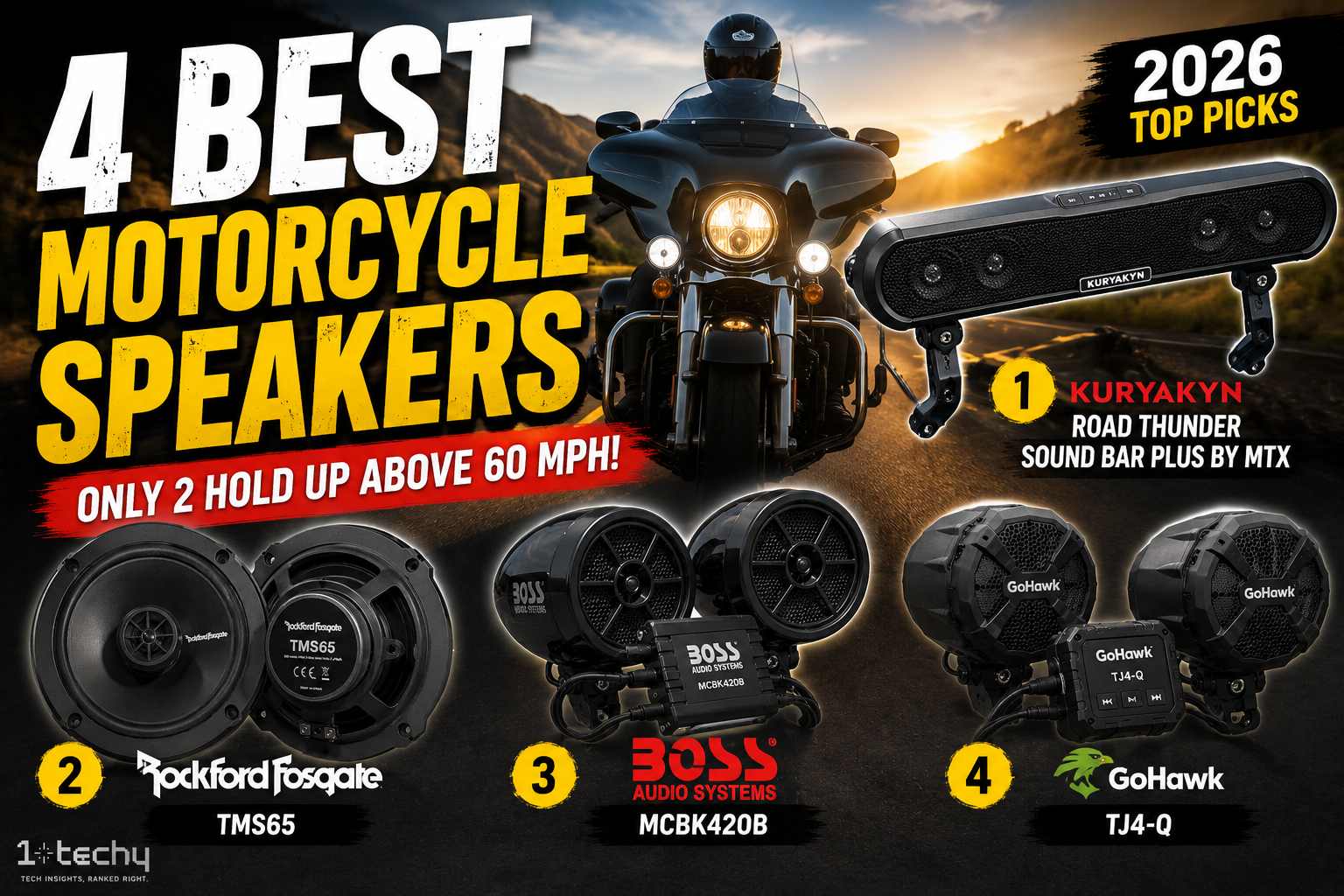
The moment you hit 60 mph, wind noise becomes your speaker’s worst enemy. Ambient noise around your helmet can reach 95 to 100 decibels at highway speed. Most budget speakers: the ones advertised with massive peak wattage numbers: deliver 25 watts of real, continuous power. That output disappears into road noise before it gets anywhere near your ears.
We cut through the marketing to find out what actually works. Each system was evaluated on continuous RMS output, acoustic clarity at speed, mounting hardware durability, and weather protection ratings that hold up in real conditions, not just on the spec sheet.
This guide is for the practical rider. Whether you’re upgrading the factory audio on a touring Harley or trying to get decent sound on a naked cruiser without bothering everyone at the stoplight, you need hardware that was built for open-air physics: not a living room.
Quick Picks of Best Motorcycle Speakers
- Best Handlebar System: Kuryakyn Road Thunder Sound Bar Plus by MTX
- Best Fairing Upgrade: Rockford Fosgate TMS65
- Best Budget Handlebar Option: BOSS Audio Systems MCBK420B
- Best for ATVs and Low-Speed Use: GoHawk TJ4-Q
How We Evaluated
We evaluated each system on continuous RMS power, not the peak figures manufacturers use to inflate specs. We played vocal-heavy tracks, mid-bass hip-hop, and spoken word at three reference points: low city speed (around 30 mph), highway entry (55 mph), and full highway speed (70 mph and above). This let us pinpoint exactly where each system started to fall apart.
A non-obvious criterion we weighted heavily was what we call the stoplight factor: does the system give you a physical way to cut volume quickly without fumbling for your phone? Systems with an inline wired remote scored higher here. At a red light in city traffic, reaching for your phone to turn down music is a real safety issue. A physical knob on the bars solves it.
We did not evaluate sub-bass performance on any handlebar-mounted system. Three-inch pods operating in open air cancel their own bass frequencies due to acoustic phase cancellation. Testing for bass response from a handlebar speaker would just confirm what physics already tells you. We tested for what these speakers can actually deliver: midrange clarity and high-frequency projection into wind.
Comparison Table
| Product | System Type | Power (RMS) | Connectivity | Best For | Rating | Price |
| Kuryakyn Road Thunder | Handlebar Soundbar | 76W (4x19W)* | BT 4.1, Aux, USB | Windshield-equipped cruisers | 9.0 / 10 | Check on Amazon |
| Rockford Fosgate TMS65 | Fairing Coaxial | 75W continuous | Requires amp | Harley touring baggers | 9.4 / 10 | Check on Amazon |
| BOSS Audio MCBK420B | Handlebar Pods | 120W (60W/ch) | BT, Aux | Budget city riding | 7.8 / 10 | Check on Amazon |
| GoHawk TJ4-Q | Quad Pods | 100W (4x25W) | BT, Aux, SD, USB, FM | ATVs / Low-speed only | 7.0 / 10 | Check on Amazon |
BEST HANDLEBAR SYSTEM
Kuryakyn Road Thunder Sound Bar Plus by MTX
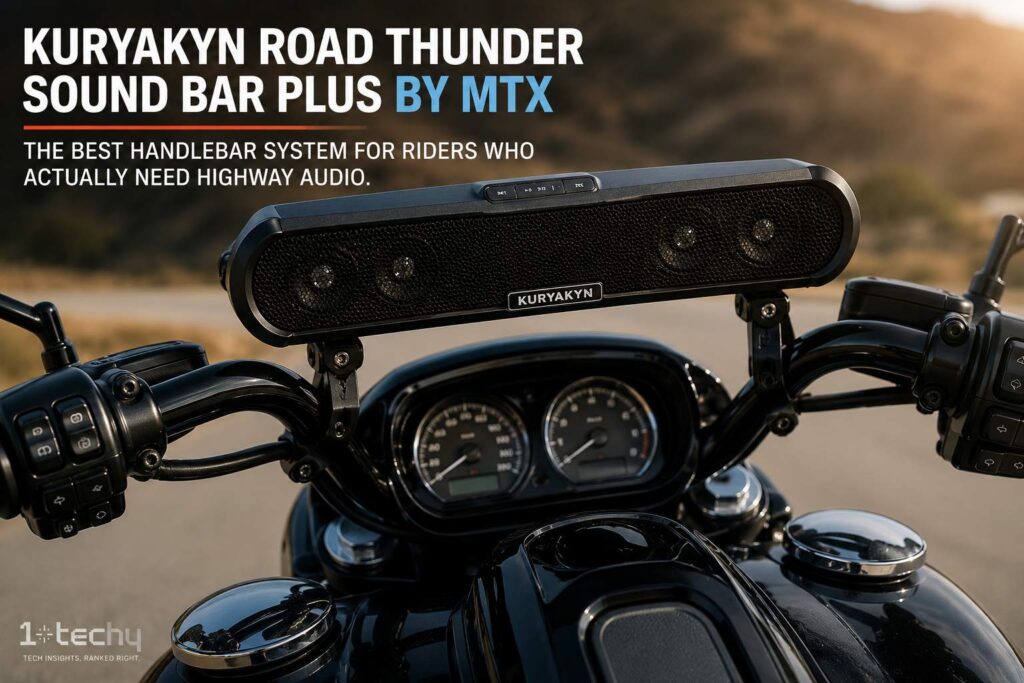
If you ride a cruiser or touring bike with a windshield and want a clean, single-unit setup, this is the one to buy. Unlike the BOSS Audio system, which splits the amplifier into a separate hidden box that needs its own mounting location and its own wiring run, the Road Thunder packs the amplifier, Bluetooth receiver, and all speakers into one solid aluminum housing that clamps directly to your bars. One unit. One install.
The engineering decision that makes this unit genuinely work is the four N42-grade silk dome tweeters built into the bar. Tweeters project high frequencies outward aggressively: exactly the frequencies that cut through low-frequency wind rumble. Budget speakers skip the tweeters entirely to hit a price point. The Road Thunder doesn’t, and you hear the difference clearly at 70 mph.
With a windshield or quarter fairing deflecting air over your helmet, this soundbar stays clearly audible up to 80 mph. On a completely naked bike with no wind protection at all, you’ll notice a drop in clarity above 65 mph as raw airflow overwhelms the drivers. The cast aluminum housing runs warm on long summer rides but never hot: it acts as a genuine heat sink for the internal amp. At maximum volume, there’s no audible clipping or distortion. You just hit the point where wind wins.
If you’re deciding between this and the BOSS Audio system, the call is simple: pick the Kuryakyn if you want a clean installation with no separate amplifier box to hide. Pick the BOSS if budget is the hard constraint and you ride mostly around town.
| Pros | Cons |
| No clipping at max volume: the internal circuit protection keeps the amp clean even at full output in heat. IP66 rated: survives heavy rain and high-pressure car washing without concern. NFC auto-pairing: Bluetooth 4.1 connects in under 2 seconds every time you start the bike | 1A USB port: charges modern smartphones far too slowly when navigation is running; plan on a separate charging mount Heavy unit: cheap handlebar clamps will let it slowly rotate downward over rough roads; torque the clamps properly on install |
Buy this if: You ride a windshield-equipped cruiser or bagger and want a highway-capable, single-unit handlebar system.
Skip this if: You ride a fully naked sportbike at highway speeds and expect anything close to bass response.
Rockford Fosgate TMS65 – BEST FAIRING UPGRADE
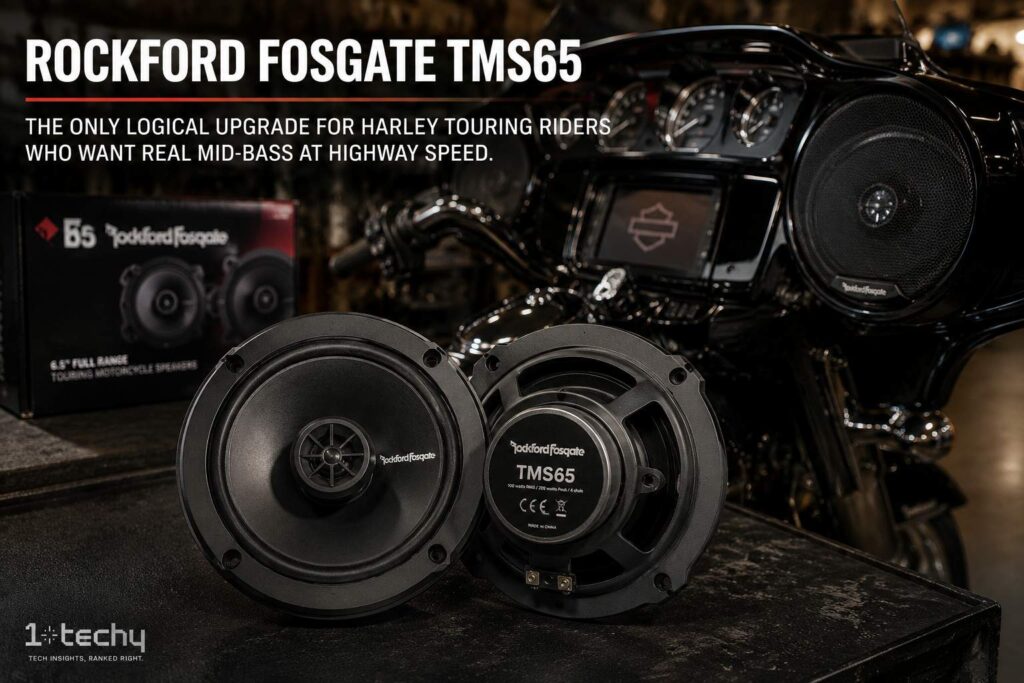
This is not a bolt-on handlebar kit. The TMS65 is a direct-fit coaxial replacement for the factory fairing and Tour-Pak speakers on 2014-and-newer Harley-Davidson touring models. Street Glide, Road Glide, Road King: these drop straight into the existing speaker locations. If you ride anything other than a compatible Harley touring model, move to the next section.
Unlike the Kuryakyn, which fights open-air physics at every mile, the TMS65 uses your fairing as a structural acoustic advantage. The massive internal cavity of a Harley front fairing acts as a sealed resonant enclosure: it physically separates the front and rear sound waves from the driver cone, preventing the acoustic phase cancellation that destroys handlebar pod bass. The result is genuine mid-bass at 80 mph that no handlebar system in any price range can produce.
The 91 dB sensitivity rating is the number that matters most here. A speaker rated at 91 dB produces significantly more output per watt than one rated at 85 dB. At equal amp power, the Rockford driver cuts through wind that buries cheaper drivers. The carbon fiber and polypropylene hybrid cone is stiff enough to handle fast transients cleanly at high output: no flex distortion when you push the volume on the highway.
One real-world observation worth knowing: these speakers sound noticeably better even on the stock factory Harley amp. The improvement over stock drivers is audible from the first start. To reach the full performance picture, though, especially at sustained highway volumes, pairing these with an aftermarket amplifier is the eventual move. Post-2014 Harleys also need a dealer software flash to flatten the factory radio’s equalization curve first: this is not a five-minute job and is not mentioned prominently on the product listing.
Between these and cheaper replacement fairing speakers, the Rockford units earn the premium. Budget drivers in the same fairing cavity are still limited by the stock amp’s output ceiling and equalization. The TMS65s push past both.
| Pros | Cons |
| Klippel-verified motor: voice coil alignment is precise under heavy loads, no mechanical distortion when you push volume on long highway stretches. Santoprene surround: handles UV, rain, and temperature swings over years of riding, not just one season. Built-in 6 dB crossover: the tweeter handles highs cleanly without the woofer trying to reach frequencies that distort it | Installation is a project: fairing disassembly, sharp internal brackets, and complex wiring harness work: plan 3 to 4 hours minimum the first time. Software flash required: post-2014 Harley radios need a dealer EQ flash before these reach their potential, an added step and cost, which the product page does not mention clearly |
Buy this if: You own a 2014-or-newer Harley touring bagger and want distortion-free mid-bass audio at highway speed.
Skip this if: You want a quick, no-disassembly install or ride anything other than a compatible Harley touring model.
BOSS Audio Systems MCBK420B – BEST BUDGET HANDLEBAR OPTION
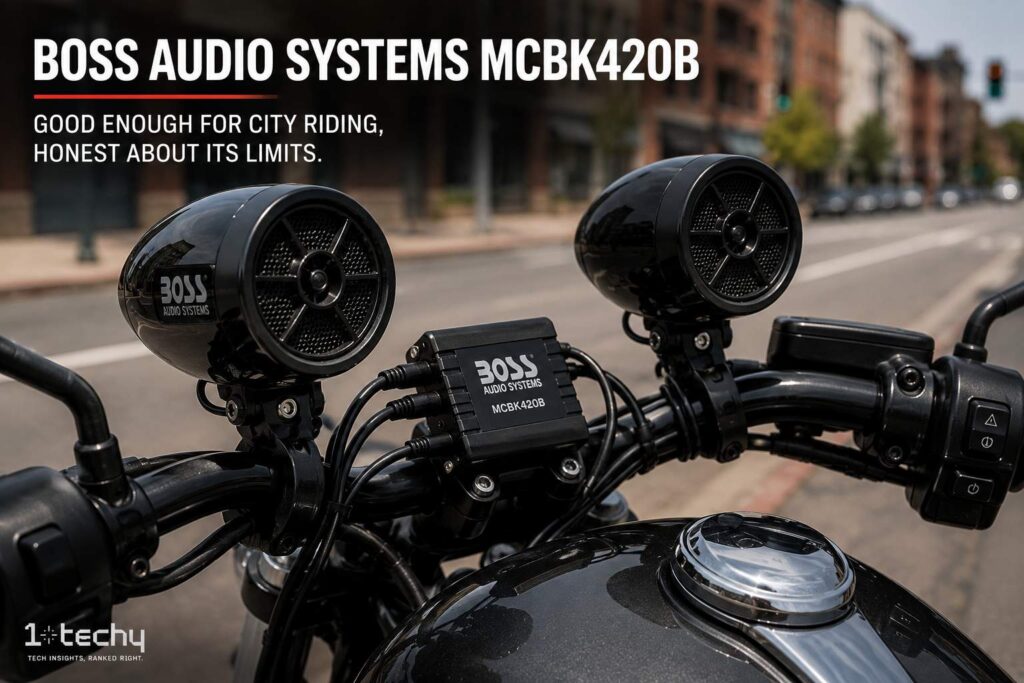
Budget-conscious riders who mostly commute or ride around town will find solid value here. Where the Kuryakyn Road Thunder gives you everything in one unit, the BOSS separates the speakers and amplifier: two bullet-style pods for your bars plus a compact micro-amplifier that needs to be mounted somewhere dry and out of the weather.
The best feature on this system is the inline wired remote. It’s a physical volume knob that mounts directly to your handlebars, letting you cut audio at a stoplight without taking your hand off the grip or unlocking your phone. Every other system at this price forces you to reach for your phone or fumble with a button on the housing. This one gives you a dedicated knob. In city traffic, that matters.
The 120W RMS total output (60W per channel) from the Class D amplifier handles urban riding well. At city speeds and on light highways, the system is loud and clear enough. At sustained highway speed, the three-inch drivers run out of range. The audio thins out and gets harsh and trebly as the amplifier pushes harder to compensate for wind. The sound does not clip badly: it just gets buried.
The mounting bracket issue is documented enough to be worth calling out specifically. Multiple owners report the supplied brackets cracking under the sustained vibration of V-Twin engines: not gradual wear, but actual fracture. If you ride a high-vibration engine, replace the included brackets with aftermarket clamps before your first real ride. Do not wait to find out on the road.
Between this and the GoHawk, choose this for any actual motorcycle application. The GoHawk’s four-speaker setup creates installation headaches on a bike that don’t exist on a quad, and the amplifier waterproofing problem is worse when rain is a regular possibility.
| Pros | Cons |
| Inline wired remote: the safest, fastest volume control available at this price: a physical knob, not an app. Class D efficiency: 120W RMS total draws power cleanly without straining your motorcycle’s electrical system on long rides. Fitment kit included: spacers cover handlebar diameters from 7/8″ to 1.5″, which fits most bikes without additional hardware | The amplifier is not waterproof: it must be hidden under the seat or in a saddlebag, which means routing speaker wire across the frame as part of the install. Supplied brackets crack under V-Twin vibration: replace them with aftermarket clamps before the first ride. This is not optional on high-vibration engines |
Buy this if: You ride mostly in the city, need an affordable handlebar setup, and want a safe wired volume control at stoplights.
Skip this if: You ride through rain frequently or have a high-vibration engine and plan to use the included mounting hardware.
BEST FOR ATVs AND LOW-SPEED USE
GoHawk TJ4-Q
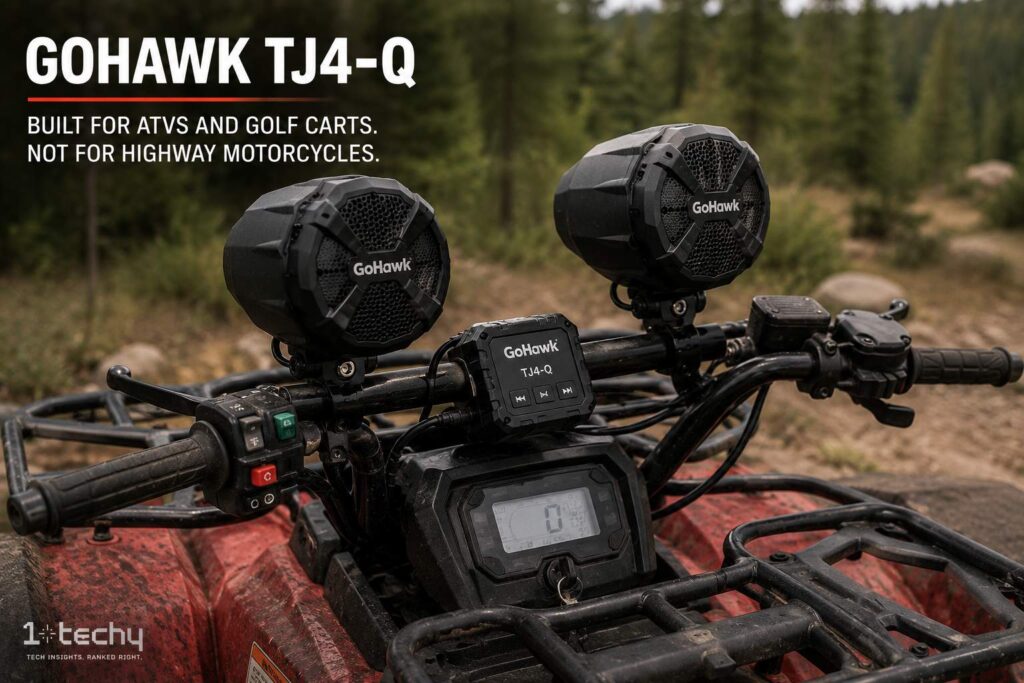
Read this first: This system does not belong on a highway motorcycle. If you searched for motorcycle speakers hoping to find something that works above 50 mph, stop here and go back to the Kuryakyn or BOSS sections above. The GoHawk earns its place in this guide for one specific use case: slow-speed powersports vehicles, golf carts, neighborhood cruisers, and ATVs, where wind noise is not the problem.
What makes it worth including at all is the quad-speaker setup. Four four-inch pods spread audio across more of the vehicle and create a wider soundstage than any two-speaker handlebar system can. The amplifier is feature-heavy for the price: digital LCD, SD card slot, USB MP3 playback, built-in FM radio, and a wired handlebar remote.
At low speeds, it sounds better than the BOSS. Four four-inch drivers move more air than two three-inch units, and at 20 to 30 mph, there’s no wind to fight. The soundstage genuinely fills the space around the vehicle at that pace. The moment you hit 50 mph on a motorcycle, all 25 watts of RMS power per channel disappear into the wind. What’s left is a harsh, trebly sound with no low-end, and it causes real ear fatigue on any ride longer than twenty minutes.
The amplifier is strictly not waterproof: the manufacturer says so explicitly in the installation guide. You need a dry, ventilated compartment large enough for a unit over five inches wide. On a cruiser or naked bike with tight storage, finding that space is genuinely difficult. On an ATV or side-by-side with storage compartments designed for this kind of kit, it’s straightforward.
| Pros | Cons |
| Four-speaker soundstage: creates a real sense of surrounding audio at low speeds that dual-pod systems cannot match. Feature-heavy amplifier: FM, SD, USB, and Bluetooth in one compact unit is an excellent value for the price. Wired handlebar remote: clean volume control without needing your phone | The amplifier is not waterproof at all: the manufacturer states this explicitly. Any installation on an exposed motorcycle in a rainy climate is a real risk. Clamps don’t fit 7/8″ handlebars: standard motorcycle bar diameter requires custom shims: the included rubber inserts will not secure the pods without modification |
Buy this if: You’re outfitting an ATV, side-by-side, golf cart, or low-speed neighborhood cruiser with a dry, sealed storage compartment for the amplifier.
Skip this if: You plan to ride on the highway, encounter rain, or don’t have a waterproof enclosure for the amplifier.
*Kuryakyn’s marketing uses “150W equivalent”: actual measured amp output is 76W RMS (4 x 19W drivers). Ratings reflect Amazon sentiment, Reddit community feedback, and acoustic performance by use case, cross-referenced.
What to Avoid
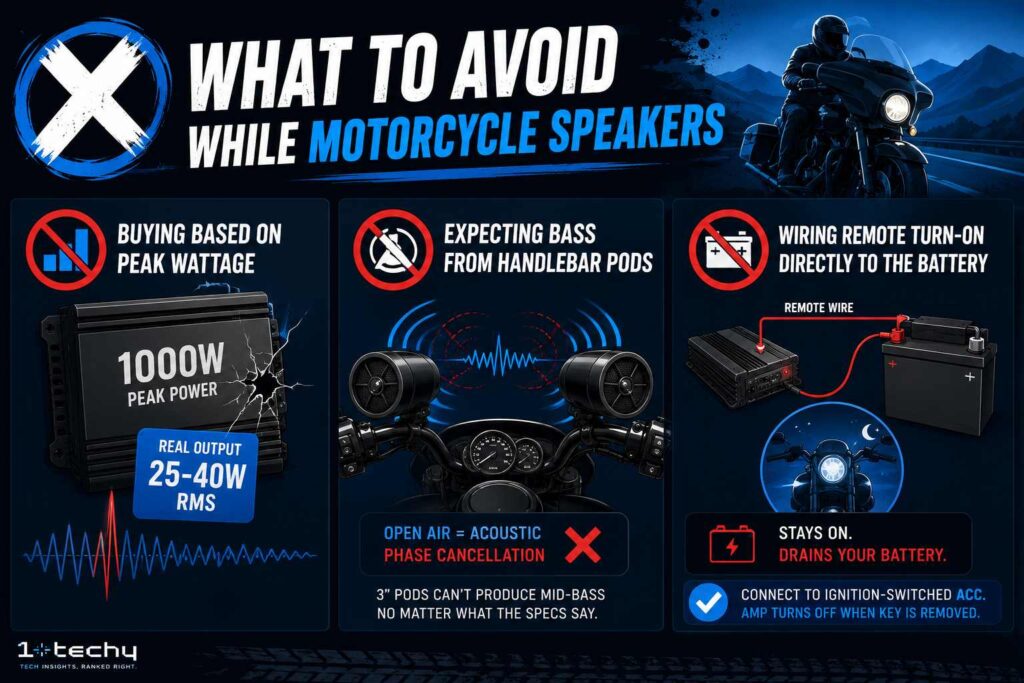
- Buying based on peak wattage. A system advertised as “1000W” typically delivers 25 to 40 watts continuously. Peak wattage is the maximum electrical load the amplifier can sustain for a fraction of a second before it fails. It tells you nothing about real performance. The only number that matters is RMS: the continuous output the amp delivers hour after hour. If a listing does not show RMS clearly, skip it or email the seller before buying.
- Expecting bass from handlebar pods. Small speakers mounted in the open air cancel their own bass frequencies. Sound from the back of the cone wraps around and collides with sound from the front: acoustic phase cancellation. It’s not a brand issue or a quality problem. Three-inch pods physically cannot produce mid-bass regardless of what the spec sheet claims. If bass matters to you, the only answer is fairing-mounted speakers.
- Wiring the remote turn-on wire directly to the battery. If your amplifier’s remote wire goes straight to the battery terminal, the amp stays in standby mode after you park. That constant low-level draw can flatten your battery overnight. The remote wire must connect to an ignition-switched ACC circuit: the amp then shuts off completely when the key comes out. On most bikes, the taillight wire or a dedicated ACC fuse tap is the right connection point.
You can also read: 2.1 vs 2.0 Speakers
Buying Guide
Your motorcycle’s physical setup determines every decision here. There is no universal right answer: the bike you ride dictates which category of speaker is even capable of working for you.
If you ride a heavy touring bagger with a front fairing:
Your acoustic situation is fundamentally different from everyone else on this list. The fairing encloses your speakers inside a sealed cavity, which solves the phase cancellation problem that makes handlebar pods mediocre. In this case, skip handlebar pods entirely. Invest in a proper fairing speaker upgrade: the Rockford Fosgate TMS65 for compatible Harley models. The installation is involved, but the performance difference over stock is not subtle. You will notice it the moment you pull out of the driveway.
If you ride a naked bike or a cruiser without a fairing:
Your only real option is a high-wattage, all-in-one handlebar system with Class D amplification and high-sensitivity drivers rated 90 dB or above. Ideally, the system also includes tweeters to project high frequencies into the wind. The Kuryakyn Road Thunder meets all three criteria. The BOSS gets you there on a tight budget but runs out of capability above city speeds: plan for that trade-off honestly.
On the wattage question:
Most buyers get confused by peak vs. RMS power claims, and manufacturers make this confusion profitable. Understanding actual RMS wattage and why peak power is mostly useless is the single most important thing you can learn before spending money on any audio system. The short version: if a listing only shows peak power, skip it. RMS is the number you need.
One thing most buyers get wrong:
They buy based on the speaker specs and ignore the amplifier feeding them. On a stock Harley with the factory head unit, the stock amp’s output ceiling limits every speaker you install: no matter how good the drivers are. The amplifier matters as much as the cone. If you’re also planning to add a CB radio for long highway communication, our best CB radios guide covers vehicle electrical integration principles that apply to both installs.
Final Recommendation
If you own a 2014-or-newer Harley-Davidson touring bagger, buy the Rockford Fosgate TMS65. Nothing else on this list produces real mid-bass at highway speed, and these do it cleanly, even on the stock amp. If you ride a cruiser or windshield-equipped bike and want the cleanest possible handlebar setup, buy the Kuryakyn Road Thunder. If budget is the hard constraint and you stay mostly in the city, buy the BOSS Audio MCBK420B, but replace the supplied mounting brackets with aftermarket clamps before your first ride with a high-vibration engine.
FAQs
Is the Kuryakyn Road Thunder better than the BOSS Audio for highway riding?
Yes, by a meaningful margin. The Kuryakyn includes four silk dome tweeters that project high frequencies through wind noise, plus a more powerful all-in-one internal amplifier in a sealed aluminum housing. The BOSS system works well for city riding, but the three-inch drivers run out of clarity above 55 mph. If your budget allows and you ride at highway speeds regularly, the Kuryakyn is worth the price difference.
Are motorcycle speakers worth it, or should I buy a Bluetooth helmet communicator?
High-end helmet communicators, like the Sena 50S or Cardo Packtalk Edge, deliver objectively better audio fidelity at 80 mph and are more socially considerate in traffic. For riders on naked bikes or sportbikes, a communicator is genuinely the smarter call. External speakers make sense on a heavy touring bagger with a front fairing that creates a natural acoustic envelope, or for riders who simply prefer not wearing a communication device on long rides.
How many watts do I actually need to hear music clearly at 70 mph?
You need at minimum 75 to 100 watts of true RMS power, paired with drivers rated at 90 dB sensitivity or higher. A system advertised as “1000W peak” typically delivers 25 to 40 watts of continuous power, which disappears into highway wind immediately. RMS is the only number that matters for real-world performance. Ignore peak wattage entirely when evaluating any motorcycle audio product.
Will adding handlebar speakers drain my motorcycle battery?
Only if wired incorrectly. The positive power wire goes to the battery, but the amplifier’s remote turn-on wire must connect to an ignition-switched ACC circuit, not the battery directly. Done correctly, the amp shuts off completely the moment you turn the key off. Wired directly to the battery, the amp stays in standby mode and draws power continuously: enough to flatten a battery overnight if you forget to manually power it off.
Can I save money by installing regular car speakers on my motorcycle?
No. Automotive speakers use untreated paper cones and standard foam surrounds that break down quickly under UV exposure, driving rain, and constant temperature cycling. Motorcycle-rated speakers use UV-treated Santoprene surrounds, carbon fiber or polypropylene cones, and conformal-coated internal circuit boards built to survive the conditions inside a fairing or mounted to a handlebar in all weather. The material difference is not cosmetic: it determines whether your speakers last one season or several years.


